Wednesday, April 28, 2010

Top 50 Old Movies: Part 2


#40: La Jetée
(The Pier)
1960

What is your strongest memory? For the dude in this movie, it’s both his fondest and most traumatic childhood memory: he saw an incredibly beautiful woman at an airport pier, followed by a horrible event -- the kid creamed and shat his pants in the same minute! This 27-minute French short is set in a post-apocalyptic future, where the survivors of World War III are forced to endure experimental time-travel in an effort to retrieve viable resources. But their primitive techniques are only able to send you back to memories you maintain a strong attachment to. Where would you go? If I got to choose, I’d go back to Spring Break, 2005, baby. But considering I don’t remember most of it, my mind would most likely send me back to grade school, where I’m getting beaten up behind the cafeteria. Stupid brain… Oh, wait! As an adult, I’d be able to stop the bullies from picking on my younger self! Those punks are going down! The Pier is one-of-a-kind; it’s comprised of photographs instead of video, and with narration instead of dialogue. Only a brief moment is shot in video -- and when that photograph comes to life, it’s one of the most beautiful moments in all of cinema. It’s all accompanied by ambient sound effects and a haunting score. I always thought it’d be fun to remake this one. All you need is a few friends, a camera, random pictures of airports and a beautiful, willing woman. Sadly, I can’t find the last one anywhere…


#39: Annie Hall
1977

This was the date film that stole Best Picture, Screenplay and Director from Star Wars. Alvy Singer (Woody Allen) is a neurotic standup comedian who falls for an eccentric free-spirit named Annie (Diane Keaton). I’m not a big fan of romantic comedies, but this one is different. It’s about the guy who doesn’t get the girl. And that’s no spoiler. Alvy reveals it first thing in a technique used frequently in the film: breaking the “fourth wall” to address the audience directly. Following the breakup, all Alvy’s been able to do is sift through all their memories together, trying to pinpoint where he effed it up. The film is a virtually plotless series of scenes that show the rise and fall of a typical relationship. They have the same problems and experiences that almost every couple go through. The dialogue is very realistic, full of “uhs,” nervous conversations and the like. Woody also employed an arsenal of artistic techniques: split-screen sequences, animation, subtitles for what the characters are really thinking, “if only life were like this” moments, and (my favorite) the characters are able to “time-travel” back to the past to watch each other’s memories. Most rom-coms only appeal to chicks, but this is one that both sexes can enjoy equally. Fellas: you’ll love Diane Keaton. Ladies: you’ll love her fashion statements. And you’ll both relate to the relationshit. Annie Hall depicts the bitter sting of heartbreak even better than Casablanca. In fact, the movie bums me out so much I only watch it when I’m feeling emotionally masochistic.


#38: Taxi Driver
1976

Step aside, Batman. There’s a new dark knight in town! Robert DeNiro is Travis Bickle, a lonely New York cabbie that grows disgusted with all the drugdealers, pimps, prostitutes and criminals around him. So he buys some guns on the black market and decides to “clean up the streets.” Bickle is a true vigilante, only he has depression and post-traumatic stress disorder instead of superpowers, which makes him all the more dangerous. It’s tragicomic how awkward and socially inexperienced he is, especially how naïve he is with women. He ignorantly takes a date to a porno theater -- his idea of “seeing a movie.” He’s not a bad guy; he's just abnormal and misunderstood by normal folk. Screenwriter Paul Schrader was clearly no stranger to loneliness. He knew only too well that loneliness is the worst when you’re surrounded by other people. And you can’t get much more crowded than the streets of N.Y. Notice how DeNiro is shot with a 450mm lens amidst an anonymous sea of people so that he’s the only one in focus. Losers will readily sympathize with Bickle, though still be shocked by the extremes at which he vents his frustration (after being dumped by a woman working at a political rally, he retaliates by attempting to assassinate the nominee she works for). As dark and violent as it all is, it actually cheers you up in the end, as Travis comes to enjoy his newfound independence. Taxi Driver was Martin Scorsese’s masterpiece, a deep character study, and one of the great punk films of the seventies. Jodie Foster was only fourteen when she played the teenage prostitute DeNiro tries to rescue, and the climactic bloodbath originally earned the film an X-rating. Composer Bernard Herrman died the night after he finished recording the score -- the best of his career. That saxophone is eargasmic!


#37: Spartacus
1960

Movies like Gladiator and Braveheart are only wanabes of Spartacus, the granddaddy of the medieval epic. It tells the true story of Spartacus, a rebellious slave who became a gladiator who became a general, then led “army of gladiators” against the Roman Empire to free every slave in Italy. Spartacus had a rough life. He’s forced to endure slavery and torture, fight his best buddy in the arena, and listen in as his babe is forced to make love to another. But despite all the tragedy, it’s miraculously inspiring. It’s a great zero-to-hero story with two of the most uplifting scenes in film history -- the famous “I’m Spartacus!” scene and the emotional finale. Spartacus, the film, waged an equally epic battle against the Hay’s Office, the notorious stuck-up censorship board of the time, who deemed the film extremely unacceptable for its visceral violence, sexual innuendo, and anti-religious themes, as well as knowingly hiring blacklisted Communists. Producer/star Kirk Douglas was a real-life Spartacus; a ballsy rebel fighting the system for creative freedom. The Hay’s Office did wound Spartacus, preventing many of the great ideas from making it to the screen. But the film did in turn strike a crucial blow that defeated the Hollywood blacklist and contributed to the fall of the Hay’s Office years later. Best of all, many of the “unacceptable” shots that the Hay’s Office cut are restored on the DVDs, including surprising moments of gory glory as well as the controversial “snails and oysters” scene, equating sexual orientation to taste in food. Both the story in the film and the story behind the film encourage you to fight for the cause, and both instances show how you can still succeed in defeat by contributing to a future victory.


#36: The 7th Voyage of Sinbad
1958

When a dark magician shrinks Sinbad’s bride-to-be to the size of thumb, the swashbuckler must sail to the island of Collossa to obtain the eggshell of a Roc for a potion that will restore her to her original size. But it’s all a ruse so the magician can get his dirty hands a genie’s magic lamp. The first of three Sinbad films made by Ray Harryhausen was also the best. It’s a classic fantasy-adventure filled with good-old stop-motion creatures, including cyclopses, a fire-breathing dragon, and of course, the debut of the skeleton swordsman, Harryhausen’s trademark. I adore stop-motion. It may not look as “real” as the contemporary CGI, but I still think it looks cooler. You can tell it was all carefully sculpted and animated by hand, which I respect way more than letting a computer do all the work. Stop-motion is such a painstaking, frame-by-frame process -- it took Harryhausen nearly a year to create all the effects for this film, and it shows. Fantasy is one of my favorite genres, especially the “medieval fantasy,” if you will. There’s just something very classical and romantic about it. Although the human characters in Sinbad are all likeable, it’s the monsters you’ll be rooting for. Whenever the sailor slays them, you tend to see why his name is comprised of “sin” and “bad.” They’re just creatures defending their territory, you big meanie! And I don’t understand why Sinbad can’t love a miniature woman. She’d never start a fight, she’d never cheat and she’d understand if you need to. She’s perfect!


#35: Vincent
1982

Tim Burton’s first commercial film was by far his best. It’s a surrealist, 6-minute fantasy about a strange boy named Vincent who, tired of his ordinary lifestyle, indulges in morbid daydreams. Like all of Burton’s films to follow, it’s very dark, childish, and self-indulgent, but he really captured something special here. Whereas many of Burton's films are clearly autobiographical exaggerations of his own pangs that are more or less inaccessible to the audience, Vincent is done so well that it allows you to vent, too. It has a strikingly unique look and feel that really draws you in. Vincent was created via that wonderful stop-motion process, with a style that resembles German expressionism. The way it alternates between reality and imagination reminded me of Calvin and Hobbes, a comic that wasn’t even in existence yet. The narration is a 58-line poem, and the narrator is Vincent Price. Like Young Frankenstein, the music is delightfully reminiscent of an old horror movie, and “The Streets of Cairo” is the theme song. It’s a beautiful little film with a totally crazy ending. Is Vincent insane? Haunted? Or just a melodramatic loner reaching out for attention? See it and decide for yourself.


#34: Raiders of the Lost Ark
1981

Whu-pu-CHH! After Spielberg and Lucas became household names, they decided to work together to make an action film about a whip-cracking, daredevil archeologist named Indiana Jones. Following the greatest opening sequence of all time, Indy enters a treasure hunt against Hitler’s merry men to win the Lost Ark of the Covenant. Booby-trapped dungeons, puzzles, chase scenes, boss battles… I love these videogame-esque movies. A lot of people don’t know that just about everything in the Indy series was lifted from old television serials. Everything from Indy’s apparel to the giant boulder can be traced back to the cliff-hangers of yesteryear. But Spielberg and Lucas combined all the classic ideas in such a fresh way that they come off as homages rather than ripoffs. In fact, Raiders practically invented a new genre. It’s a collage of action, horror, romance, spy movies, westerns and fantasy. Most people call it an “adventure film.” Personally, I consider it a superhero film. Now, I know what you’re all saying -- Indy ain’t no superhero! Well, why not? He may not have superpowers, but neither did Batman. And Indy has all the traits of a common superhero: he's a regular professor by weekday/larger-than-life hero by weekend, he’s got his own trademark costume, a weapon of choice, an Achilles’ heel (Ophidiophobia), he’s always accompanied by a sidekick, the action scenes are super comic-book style, and he’s constantly battling supernatural forces and maniacal villains to save the world. As if the Spielberg-Lucas collaboration wasn’t cool enough, they got Lawrence Kasdan to write the script, Harrison Ford to star, and, of course, John Williams to write the score. It was the dream team!


#33: Stand by Me
1986

This is one of those special movies that feels like it was made just for me. And yet, I wasn’t surprised to learn that every fan of the movie feels the same way. Set in the fifties, it follows four teenage boys who set out to find the body of a missing classmate. Along their journey, they dodge trains, cross a leech-infested swamp, and outrun a junkyard dog trained to “sick balls.” The R-rated film is ironically the most nostalgic film I’ve ever seen on childhood. The characters are just so real. There’s Gordy, a talented writer struggling with depression; Chris, a reformed “bad apple” who finds it impossible to get a fresh start in a small town; Teddy, the hot-headed son of an abusive father, and Vern, the simple, chubby, happy kid who serves as the comic relief. I love these guys. Most people will be able to identify with one of them and liken friends to the others. All four leads are fantastic, as is Keifer Sutherland as the psychotic leader of their rival gang. Based on a short story by Stephen King, the screenplay is full of wonderful and unique touches, like a complete non sequitur that comes when Gordy tells the others an original campfire story about an overweight bully victim called “Lardass.” The soundtrack is comprised of classic 50’s songs, including the hit it was titled after. My only complaint is the dangling subplot about Gordy’s dead brother that never quite satisfyingly connects with the rest of the story. Other than that, the film stands high by my standards.


#32: Sherlock, Jr.
1924

This is the last of the short surrealist films, I swear! Sherlock, Jr. is a gem that’s slipped through the cracks, perhaps due to how ahead of its time it was. At 44 minutes, this comedy plays more like a big-budget, “hour-long” episode of a sitcom than a movie. Buster Keaton plays a kid who works at a movie theater but dreams of being a detective. He’s framed for stealing a pocketwatch from his girlfriend’s father and, despite his amateur sleuth efforts, is unable to prove his innocence. But then he falls asleep on the job and dreams he’s Sherlock, Jr., a renowned detective on a similar case. And that’s where the real fun begins. Writer/director/star Buster Keaton was as brilliant as he was daring. He performs all sorts of impressive stunts that double as hilarious gags, invoking awe and laughter at the same time. One scene finds him shooting pool with the villains, who have swapped out the 13-ball for an explosive replica ball that will detonate on impact. The suave Keaton effortlessly shoots an unbelievable game all around the ball, narrowly avoiding contact the entire game! In the scene where he jumps from the speeding train to the water spout, Keaton actually broke his neck (non-fatally) and didn’t find out until many years later. If it wasn’t a silent film, you could probably hear the crack. You never see modern actors performing such impressive and dangerous stunts. Today, it’s all done with doubles, wires and special effects, which is what makes these oldies such treasures. Keaton’s the real thing, and you can tell. But he also uses neat special effects of his own, like dissolving a wall so you can see through it, and superimposing “imaginary” footage into reality. Keaton was the Sherlock Holmes of filmmakers -- bloody brilliant!


#31: Double Indemnity
1944

This was the definitive film noir, another one of my favorite genres. A blonde bombshell sweet-talks an insurance salesman into off'ing her husband so they can run off with the payoff. And get this: his insurance company pays double if the victim dies in a rare freak accident, like, say, from falling off a moving train. I love noir; dark, dirty stories with equally dark lighting. They were a guilty pleasure to indulge in, inviting you to suspend your morals and take a walk on the wild side. D.I. takes you through such a detailed step-by-step process of planning, committing and covering up a murder that it actually makes you feel like you were a part of it, making it one of the most suspenseful films to sit through. The wife (Barbara Stanwyck) was the definitive femme fatale, a treacherous tramp that will destroy all your trust in women. Fred MacMurray is great as the poor sap who falls for the siren’s song, and Edward G. Robinson is even better as his suspicious boss who delivered all his lengthy, lightning-fast monologues by memory.  This is a great example of how classy old movies were. It has just as much sex and violence as a modern film, only the camera chooses to look the other way.  Instead of actually showing nudity and sexual content, it fades from passionate kisses (with climactic music) to the classic “buttoning up” scene and a post-sex cigarette. Gotta love it! And instead of seeing the salesman break the husband’s neck from the backseat, we only hear the noises as the camera focuses instead on the she-devil's cold smile in the driver's seat. The main reason young’uns don’t like old movies is because “you never get to see anything.” Well, the main reason I don’t like new movies is because you never get to imagine anything.


20 down, 30 to go! Click here for Part 3.

Saturday, April 17, 2010

Top 50 Old Movies: Part 1

Old movies have such a bad rep with the younger crowd, which is a real shame. Why do so many people see all their movies in theaters? I don't get it. Is it to keep up with the gossip? Is it for the bigscreen experience? Or is everyone just addicted to the Hollywood drug that is CGI? When I have kids, I'm not letting them climb the branches until they know the roots. I say, be a moviecomer, not a moviegoer. Sadly, the generation gap only widens further when film snobs make those prestigious "greatest films of all time" lists that always consist of the most historically important yet boring choices. Sure, it’s cool if a movie was groundbreaking or influential, but come on, that's not what makes a film great to begin with. The most important thing about a film, in my mind, is how entertaining it is. I much prefer Kong over Kane, Star Wars over 2001 and spaghetti westerns over real westerns. So I decided to make my own list. It only had two prerequisites: I had to love the film and it had to come out before 1990.


#50: Fast and Furry-ous
1949

Back in the day, moviegoers were often treated to short films before the feature presentation. From 1933 to 1944, you could see Looney Tunes, Warner Bros.' classic animated comedy sketches, which introduced some of the greatest animated characters of all time including Bugs Bunny, Elmer Fudd, Daffy Duck, Porky Pig, Sylvester, Tweety Bird, Marvin the Martian and Tasmanian Devil. These shorts were later be broadcast on television, which is how my genearation saw them. My favorite Looney Tunes are the ones with Roadrunner and Wile E. Coyote. Coyote was always trying to catch the Roadrunner in Death Valley using super-overelaborate plans and malfunctioning Acme contraptions. The duo's very first sketch, Fast and Furry-ous, is easily my favorite. It features so many classic gags, like Coyote painting a fake tunnel on a wall to trick the Roadrunner into running into it, who actually runs through the painting as if the tunnel were real. Then of course, when the Coyote tries it, he crashes into the wall. I love that goofy cartoon logic, like how an animated character can take a long walk off a short cliff without falling until they realize they're actually defying gravity. These shorts do piss me off though, as I was always rooting for the Coyote. His schemes were so clever, while that damned Roadrunner was such a cocky nuisance. Sadly, the predator never caught his prey, unless you count the end of Soup or Sonic, in which a shrunken Coyote catches the "giant" Roadrunner and is unable to eat him. It teaches kids a valuable life lesson: you will never win, so why even try?


#49: 龍爭虎鬥
(Enter the Dragon)
1973

WU-TAAAH! Bruce Lee was the iconic figure of the martial arts film, and Dragon was his opus. Lee plays a Shaolin martial artist hired by the U.S. government to enter a fighting tournament held on a private island in order to bust the island’s drug racket. He’s a kung fu master by day and a ninja by night -- how has this not been made into a videogame? For a Hong Kong action film, the writing is phenomenal! In other words, the script is almost good! There's actually a story, the dialogue isn't half-bad and the characters are somewhat developed! On top of that, the English voice-dubbing almost matches! But you'll forgive the shortcomings when you see the fight scenes, which, I assure you, are many of the best ever filmed -- all in one movie. Get this: Lee was so fast that the filmmakers actually had to slow down the frame rate just to capture his moves on camera, as opposed to many modern action films, where the action is sped up to make stunts appear more dangerous than they really are. The final boss battle takes place in a hall-of-mirrors, where Lee faces an opponent armed with a huge, metal claw (this was a year before the debut of the X-Men character Wolverine). Dragon gained enormous popularity in both Hong Kong and America, launching Lee into international superstardom. Bummer he didn’t live to see it hit theaters. At age 32, he died of mysterious causes. At least he was able to give such an awesome dying gift to the world.


#48: Young Frankenstein
1974

Mel Brooks is a very unique writer/director; all his films are parodies of other genres. He’s spoofed everything from silent comedies to historical epics. But it was his comedic spin on Frankenstein lore that became my personal favorite. If you liked the animated television sitcom, The Simpsons, back when it was in its prime, you’ll love Young Franky. It’s like, the exact same kind of humor. Gene Wilder is perfect as the title role, a descendant of Victor’s, who refuses to acknowledge his heritage -- “it’s pronounced FRONK-EN-SHTEEN!” Then there’s Igor, the goofy hunchbank, Inga, the busty assistant, The Monster, and a slew of funny supporting characters. Every cast member seems born to play the roles. The filmmakers wonderfully recreate the style of an old Universal horror film. The opening credits actually make you feel like you’re watching a movie from the 30’s. Brooks insisted they shoot in black-and-white, which was very rare for the seventies. Most of the equipment in the lab were even the same props used in the 1931 Frankenstein. I really dig the old-fashioned, gothic score. You may recognize a five-second segment of it from Dramatic Chipmunk. Even though this is a satire, I actually think it’s the best Frankenstein film out there. There was so much potential humor in the source material, and combining classic horror with classic screwball was a stroke of mad genius. Brooks stitched old, dead ideas together and brought them back to life again. The result is a riotous disasterpiece.


#47: The Naked Gun: From the Files of Police Squad!
1988

In this hilarical mix of slapstick, screwball, spoof, dark and absurdist humor, Leslie Neilsen is detective Frank Drebin, a deadbrain detective full of deadpan one-liners, OJ Simpson (yeah, that OJ) plays his accident-prone yet death-proof partner, Ricardo Montalbán is the way-too-serious villain and Priscilla Presley is the sexy sex-joke device. The plot revolves around a plan to assassinate Queen Elizabeth II during a baseball game in the States, but I’ll be honest. The paper-thin story is nothing more than groundwork for the high-speed, no-brakes, endless barrage of jokes. This movie must have about a thousand of them. Most of them will make you chuckle, some are so bad you’ll laugh at them anyway, and some are so hysterious you’ll have to pause the film to recover. After the movie, I immediately Youtubed the short-lived television series it was based on, Police Squad!, which was cancelled after only six episodes due to how much audience attention it required to pick up on all the dry and subtle humor. Some people just don’t know when to laugh without a laughtrack. The film’s a little more flamboyant -- in a sex-scene that satirizes the AIDS scare of the 80’s, the characters put on full-body condoms. Hard to miss that. However, those paying attention will notice plenty of jokes that the idiots and multi-taskers are sure to miss, like the way Frank’s rank is constantly changing, sometimes mid-sentence, or how he walks around the walls of sets instead of through the doorways. Naked Gun isn't my favorite comedy, but it definitely gets my vote for the funniest. I’ve never laughed more or harder during a movie.


#46: Les Diaboliques
(The Devils)
1955

BrrRRRrr! What a chiller! After a dirty principal starts having an open affair with another teacher, his wife and mistress join forces to murder him and dump his body in the school’s swampy swimming pool. But when the pool is drained in the Spring, the body is gone. And that’s only the beginning of the eerie events that haunt the school. Henri-George Clouzot’s new wave French horror film is one of the most disturbing and unnerving films ever made. Unlike modern horror films, nothing pops out at you and there’s no gross-out gore; The Devils relies on creepy, mysterious occurrences to slowly build genuine terror. Instead of making you jump, it will make you shiver. It will make you cry instead of scream. It will elicit verbal responses like “no way,” “ohmygod,” and “That’s it. Turn off the movie and turn on the lights!” It was a major influence on Psycho, which came out five years later, which, spookily, was also the same year one of the Devils stars died the same way they die in the film! Beware: I don’t recommend seeing this one unless you’re really ready to get freaked. It’s the kind of film that generates paranoia that will continue long after you see the film, like Jaws or, to a lesser extent, The Truman Show.


#45: Indiana Jones and the Last Crusade
1989

In Indy’s third adventure, the whip-cracking, daredevil archeologist races the Nazis for the legendary Holy Grail. Crusade was my least favorite of the first three. I found it to be too preachy and too similar to Raiders, recycling the same villains, Nazis, and the same mythology, Christianity. Other than that, it’s still a hell of a film. The action scenes are spectacular, including a boat-chase through Venice, a biplane dogfight over Berlin, a motorcycle chase through Berlin and a tank battle in the Hatay desert. The finale pits Indy against a series of puzzles in a trap-filled dungeon. It’s all very videogame-esque. Sean Connery was brilliantly cast as Indy’s father, who makes a great side-kicking side-kick. When it comes to writing characters, opposites attract audiences. The Joneses are a great example. They’re constantly bickering when they should be cooperating, adding a whole new layer of excitement to already-exciting scenes. The Indy films were synonymous with great opening sequences. Here, River Phoenix plays the teenage Indy in a flashback that shows how the character acquired his iconic hat, whip, fear of snakes and even the chin-scar that Harrison Ford's always had from a car accident. Crusade was a great ending to a great trilogy. That’s right, I don’t count that crappy fourth film made in 2008. Although the filmmakers finally realized the importance of having fresh villains and mythology like Temple of Doom had, the magic was long gone. I’m kind of sad they didn’t keep the series running with new actors like the Bond franchise. After all, Indy did drink from the Grail, so it would only seem fitting for his character to live on forever. Oh well. We'll always have the first three.


#44: To Kill A Mockingbird
1962

Everybody’s seen this one -- probably as an alternative to reading the novel in high school. Atticus Finch is a small-town lawyer who chooses to defend a black man accused of raping a white woman… in 1930’s Alabama -- you know, back when there was still racism in the South. Meanwhile, his children, Scout and Jem, become fascinated with a mysterious neighbor they’ve heard many a strange story about though have never seen. Part courtroom-drama, part coming-of-age story, Mockingbird is one of those adaptations where everything came together perfectly. Like Harper Lee’s novel, it captures the time and place so well, you’ll feel like a Maycomb resident yourself. The film always gives me a temporary hick accent and IQ reduction. It has superb direction, moody cinematography and a tightly adapted screenplay. The performances are knockouts, not only from Gregory Peck and the kids, but from all the supporting roles as well, including Robert Duvall’s screen debut as Boo Radley and Brock Peters as the “innocent” Tom Robinson. Yeah, I’m still pretty sure Tom was guilty. One advantage films have over books is the music, as Elmer Bernstein’s evocative score proves thoroughly. Atticus is one of the great movie heroes -- a justice fighter, a smart lawyer and the best dad ever, teaching his children (and the audience) the importance of doing the right thing, no matter what the consequences.


#43: Casablanca
1942

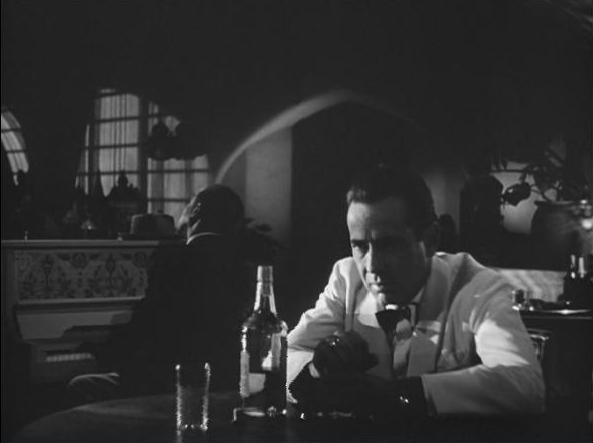
You must remember this. A film is just a film. Reviews are just reviews. No fundamental truths apply, but as time goes by, Casablanca is among the most consistent entries on everyone’s list. It’s the perfect movie to watch after you've been dumped, especially for guys. Anyone who’s had their heart broken badly can totally empathize with Rick, a cold, cynical nightclub owner who acquires the only plane tickets out of occupied Nazi-Morocco. In walks Ilsa -- the reason for his emoness -- with her new boytoy, desperate to flee the country. It's a great "love and war" drama that depicts those horrible feelings oh so wonderfully -- the way Rick can’t stand their old song yet still yearns to hear it, his disinterest in everything from other women to the War, and in his opening shot, what is he doing? Playing with himself. Granted, it’s a game of chess, but that’s about as suggestive as you could get in the forties. It was a very topical film (released less than a month after Allied Forces entered WWII) that had a huge impact on the nation, reflecting America’s shifting attitudes about the war and even inspired intervention. But personally, what I found to be the most influential thing in the film was the incredible amount of smoking and drinking. Sure, cigarettes were common in old movies because it looked so cool in B&W, but holy Marlborough! Try playing the drinking game during this movie. I dare anyone to take a shot every time a character takes a drink or a drag. You’ll pass out before Ingrid Bergman even enters the picture.


#42: The Terminator
1984

This was the iconic 80’s film. Robots, time-travel, car chases, gunfights, techno, miniatures, big hair… Terminator’s got it all! Two warriors from the future warp back to 1984: one is a cyborg assassin sent back to murder Sarah Connor, whose son will go on to lead a war against the machines in the post-apocalyptic future; the other is a soldier sent back to protect her. Terminator mixes action, sci-fi and horror into a gripping thriller that grabs you right from the start and only squeezes tighter and tighter. It was the breakthrough film for James Cameron, who would later make some of the most expensive films ever made. But I don’t give two shits about 3D movies if the characters in it are all one-dimensional. Terminator has a superb script that boasts strong characters, thought-provoking concepts and clever twists. Arnold Schwarzenegger is perfect in the title role, a single-minded, endlessly persistent, practically invincible hunter, one of the greatest screen villains of all time. Ahnold is so buff, it hurts just looking at him. The human soldier sent back to stop him doesn’t stand a chance, which is what makes the battle so exciting. The oldschool, low budget special effects are bound to elicit one of two reactions: "So fake!" or "So dank!" As a child, I thought that metal endoskeleton was the coolest monster ever. I would draw him all the time. Now that the effects have aged and I can tell it's all puppets and stop-motion, I think it's even cooler! Somehow, knowing how they did it engages me in the film even more. The only problem with the movie is it suffers from having the greatest sequel of all time. I’ll be back to review that one someday!


#41: Old Yeller
1957

I hate this movie, but it was an obligatory inclusion. In 1860’s Texas, young Travis becomes the man of the family farm after his father goes on a three-month cattle run. When a troublemaking stray dog appears, Travis wants nothing to do with it… but the mutt slowly grows on him. Yeller was the quintessential dog movie: a coming-of-age story filled with charming “boy and his dog” scenes, great animal stunts, and (SPOILER ALERT!) a heartbreaking, gut-wrenching, tear-jerking climax that caused many parents to shield the ending from their children. There was a Friends episode where a shocked Phoebe finally saw the real ending on TV, as her mother had always turned the movie off early, tricking her into thinking it had a happy ending. This was actually common practice in many households. Audiences in '57 didn’t even know what was coming. It was quite daring of the filmmakers to throw such a curveball ending on an otherwise lighthearted Disney western-family film. However, I think the film should be mandatory viewing for all dog owners. Strap the kids down and tape their eyes open. They gotta learn that Sparky ain't gonna live forever. At least the film has an uplifting resolution. This is more than just a movie; it’s a rite of passage.


And I'm just getting started. Click here for Part 2.

Thursday, March 11, 2010

5 Great Videogames to Play During Sex


Guys, don’t you hate it when you’re bangin’ a chick, she’s taking FOREVER to orgasm, you’re trying hard not to, and all the while you just wish you could get back to playing videogames? Well, sex is about to get 100 times better for both of you! Here are five different kinds of games that are easy to play while you “joystick” your princess. She may object to the idea at first, but after showing her how long you can last while multi-tasking, she’ll be begging you for a good game-and-fuck every time. Who knows? Maybe she’ll even want in on the “action!”


#5: One-Handed Games

Arcadian games like Pac-Man and Frogger only require one free hand to play. And just how many hands does your bitch need? Many simplistic computer games can be played with only the mouse. How embarrassing would it be to your online Chess opponent if you could checkmate them while you chick-mate? As for console games, go into the options menu and customize a controller scheme to match your favorite position.


#4: Button-Mashing Games

If your girl is the kind that demands both hands on her at all times, this is the perfect rebuttal. Button-mashing games only require one finger! And if she demands all ten fingers, she’s too needy, bro. Button-mashing while you butt-mash is a great way to earn money in gambling mini-games. Nothing like getting paid while you’re getting laid! Sure, you’re not making real money, but chances are you’re not making real love, either. You could even let her get on top, stick the controller under your ass and let her do the work!


#3: Metal Gear Solid Games

Notorious for their intolerably long cut-scenes, the MGS games are more like half-videogames, half-movies. Nobody cares about the stories in those games, but nobody wants to skip the cut-scenes either, as they do occasionally contain important information. The short films are typically around ten minutes long, which should be way more than enough time to satisfy your hoe. The further you get in the series, the more frequent and endless the cut-scenes become -- MGS4 has cut-scenes that last over an hour! But dividing your attention is a great way to prevent you from blowing your load, and I suspect these games were designed for just that purpose. After all, the protagonist's name is Solid Snake.


#2: Waiting Games

This one’s for the ladies. I know how much you females love simulation games -- probably because they require such little skill. Many sim games require you to spend copious amounts of time with the game on, whether you’re actually doing anything or not. This allows your cities to develop, cash to flow and pets/children/plants to grow without ever having to interfere. If it’s a computer game, you can leave it on 24/7 and only monitor it occasionally. But if it’s a console game, the playtime has to be limited so you don’t start a house-fire, which gives you the perfect opportunity to make some heat with your man while your console overheats. And dudes, if your she-devil insists you unplug the games before you plug into her, you better march right into the other room, log her off Farmville, close her Sims 3 window and break open her Tamagotchi.


#1: Automatic Games

Similar to “waiting games” only manlier, “automatic games” are the ultimate games to have on while you get it on. Role-playing/strategy games like Ogre Battle and Final Fantasy Tactics feature an “auto-battle” feature, allowing AI to fight the battle for you. This is very convenient, considering the battles can take up to a half hour. All you have to do is get in a battle before you get in your woman and you’re good to go, as long as you keep one eye on the screen. Sometimes, role-playing/hack-and-slash games feature endless swarms of easy enemies, which is a great way to level up if you have an autofire controller/tape a button down and leave the game running (Final Fantasy VI, Gauntlet Legends). But beware: autopilot can be risky. If the tables turn in-game, you’ll have to pull out, which may cause your lover to accuse you of (how did she put it?) “ruining the moment.”

Sunday, March 7, 2010

Top 5 Game Boy Games


I'm not a big fan of handheld systems. I don’t mind the microscopic screens, the vampiric need for fresh batteries or the fact that they’re a step backward, technologically. No, what I resent is the game selection. To balance out the advantage of portability, it seems 99% of handheld games are nothing more than inferior wanabes of great console games. ALL the popular series got lesser remakes on the Game Boy. It’s as if these trashy games were just meant to hold you over on trips until you got home to the real thing again. Like a hooker. Yeah, the Game Boy did have Tetris, but having already read my previous lists, you all know that was originally an arcade game and thus doesn’t qualify here. However, the nineties were such a great decade for videogames that even the sexist cinder block with black-and-white -- er, black-and-green graphics had a handful of great titles.


#5: Kwirk
1989/90

You may tomato, I say Kwirk. Everyone knows Tetris, but who’s ever heard of Kwirk?! NO ONE, that’s who, which is a total bummer, because Kwirk is infinitely superior. That’s right, I said it, and I’ll say it again: Tetris is overrated! *flinch* Sure, Tetris may have been a classic arcade game, but it’s just so simplistic, I hardly consider it a puzzle game at all. It merely tests your reflexes, whereas true puzzle games (like Kwirk) challenge your brain. And while the Game Boy version of Tetris did introduce the classic theme song, it couldn’t even save your high scores. Kwirk is very similar to the Lolo games on the NES. The title character is a tomato in shades tasked with completing a series of puzzles to save his girlfriend-tomato so they go back to making sweet, beautiful Ketchup. There are three different modes. “Going Up?” is the main game, a linear series of thirty puzzles, ten per difficulty. These diabolical little brain-ticklers consist of boxes that can be pushed but not pulled, pits which can be filled with boxes and revolving turnstiles. Some rooms feature a second vegetable character, requiring you to switch back and forth between the two in order to guide them both to the exit. These puzzles are brilliant but extremely difficult, requiring a lot of trial and error. Thankfully, you can undo up to eight moves or simply redo the entire level whenever you want. There’s also a level select, which more than compensates for a lack of a save feature, as it also allows you to skip a level if you’re too retarded to figure it out. The second mode is “Heading Out?” which allows you to play however many puzzles you want on random. I never played much of it, but I suppose it’s a good time-killer if you’re on a long trip and have already beaten the main game. Finally, there’s “Vs. Mode,” which allows you to race another player (via link cable) to see who can complete puzzles faster. But let’s be honest, if you’re linking two Game Boys together, it’s gonna be for Pokémon. Still, Kwirk is a great little puzzler that should always take priority over Tetris on vacations.


#4: Kirby’s Dream Land
1992

King Dedede stole all the food from Dream Land and everyone’s gonna starve unless Kirby steals it all back! How did this game not win Best Screenplay?! Oh, I forgot, Super Mario Kart came out the same year. The first-ever Kirby game is so old, the balloony bastard doesn’t even have his trademark ability to steal powers from enemies. All you can do is suck them, followed by spitting or swallowing -- damn, Kirby games are dirty! The lack of the copy ability actually adds a good element of challenge to a series that would later become too devoid of difficulty. In most Kirbies, all the powers allowed you to just walk through enemies (and bosses). But the original forced you to be more resourceful, using enemies against each other, and bosses required you to successfully evade their attacks until they gave you an object to shoot back at them. As usual, Kirby can fly forever, so the game’s still a piece of cake. The easy gameplay, mixed with a happy, upbeat soundtrack makes it an irresistible little feel-good game that’s guaranteed to cheer you up and give you the false impression that you rock at videogames. Kirb’s one of the most recognizable videogame characters ever, but get this: his model was created only as a temporary sprite to testrun the levels until the artists actually gave him more detail. But, as history’s proven, simplicity rules! The only problem with this game is its measly serving of five levels. Beating the game unlocks a higher difficulty level, but even that will leave you hungry.


#3: Kirby’s Dream Land 2
1994/95

Recipe for Kirby's Dream Land 2:

1) Take Kirby's Dream Land
2) Add 26 more levels.
3) Add a save feature.
4) Add animal buddies.
5) Add collectibles.

The pink pussy returns to thwart King Dedede. Again. It’s no surprise why this game won Best Screenplay, 1994. Take that, Final Fantasy VI. Okay, so the story’s nonexistent, but that's not why we play 8-bit games. That's like eating a great restaurant and criticizing the lack of decor. With a whopping 31 levels, Dream Land 2 made the original feel like an appetizer. It was actually the third Kirby game (the in-betweener being Kirby’s Adventure on the NES), and it continued many of the concepts introduced in Adventure, like the copy ability and collectibles (YUM!). The game introduced three animal friends that Kirby could ride on once he rescues them. There’s Rick, a hamster that runs fast and doesn’t slip on ice, Coo, an owl that can fly against the wind and allows Kirby to inhale midair, and Kine, a fish that can swim against currents and allows Kirby to inhale underwater. Your special power is also enhanced when riding an animal. For example, Kirby alone can only use the fire power horizontally. But when riding Rick, he can also use it vertically, allowing him to melt ice blocks above him. There are seven Rainbow Pieces hidden throughout the game (one in each world), and some can only be obtained with the right combination of power and animal. If you get all seven pieces and beat the game, you unlock a new weapon, a new boss AND a new ending! Talk about a great dessert.


#2: The Legend of Zelda: Link’s Awakening
1993

Like a dog that pisses on every fire hydrant, Nintendo just had to mark every console with a classic Zelda game. Showoffs. But of all the games in the series, this one actually surprised me the most. It was a very ambitious, unique game that truly overcame the Game Boy’s limitations. Unlike the other Zelda titles, this one wasn't set in Hyrule. There’s no Zelda, no Ganon, and no Triforce. Instead, it’s set on Koholint Island, where Link is stranded until he can wake the Wind Fish, which can only be done by gathering the eight Wind Instruments. Why are these games called Legend of Zelda, anyway? It should be Legend of Link! That bitch doesn't do shit! Link's Awakening featured an exclusive Zelda item: the Feather (actually from Super Mario Kart), which allowed Link to jump! The game also featured a customizable button scheme for your items, and two items could be used at once -- you can guard with your shield while you swing your sword; using bombs with the bow ‘n arrow fires an explosive arrow; and with the Pegasus Boots and Feather, you can get a running start and jump huge pits! But where the game really shines are in its dungeons. The complex, brilliant designs are truly the best in the entire series, featuring some clever puzzles that require real intelligence. The game has a comedic script full of references to other Nintendo games including Mario, Kirby and SimCity. The only downfall is that the game suffers from being sandwiched between the two all-time best Zelda games: Link to the Past and Ocarina of Time. Thus, people tend to not take this one as seriously since the Game Boy theoretically lacked the same potential as the consoles. But believe me, Link’s Awakening met the challenge head-on, becoming my third-favorite in the series.


#1: Pokémon
1996

Step aside, Mickey, there's a new mouse in town. This simple, complex and extremely addictive RPG was about capturing wild creatures called Pokémon and training them to fight each other. Two versions of the game were released simultaneously: Red and Blue (which were Red and Green in Japan). Though the versions were largely identical, each contained Pokémon that the other version did not. The idea was to find other kids with the opposite version and trade them with a link cable so you could “catch ‘em all.” The link cable also allowed you to fight each other -- the highlight of the game. I will never forget the “Pokémania” that swept across my school in the mid-nineties. All the cool kids were playing Game Boys at recess (and even under the desk in class). The game brought a whole generation of gamers together in person instead of isolating them at home.

Despite being controversial for promoting evolution and animal cruelty, the game became un-fucking-believably popular, leading to a dozen sequels, an animated TV show, a card game and virtually every type of merchandise imaginable. I wouldn’t be surprised if there are Pokémon sex products. After all, Pokémon does stand for “Pocket Monsters.” I can just picture the ads for Pokéviagra: “Turn that Magikarp into a Gyarados!” There’s probably even Pokémon birth control. I’d wear a Diglett condom.

Today, there are like 500 Pokémon; most of them uninspired variations of the old ones. But back in the day, there were only 151, and I still know them all by heart. The creatures were very imaginative, like something out of a Dr. Seuss poem, with memorable names like Charmander, Bulbasaur and Squirtle. Each Pokémon had a different “type,” and battles primarily depended on exploiting your opponent’s weaknesses, like using water types against fire types. If you want to complete your Pokédex, you’ll need at least two other friends to play through the game simultaneously, or you'll have to convince some vets to dust off their old Game Boys to make the necessary trades.

The replay value is endless -- even after you beat the game and collect all 151, you’ll still spend hours preparing for and dueling your friends with different teams. I'm normally very against resorting to the internet for help, especially before beating a game. But this is one of the very few games where I think online resources actually benefit the experience. There's just such a burning desire to be the very best and yet it's so difficult and time-consuming to weed out all the good Pokémon and movepools from the bad. After all, in the world of Pokémon (which is full of fellow Pokémon trainers, collectors and researchers), it's only realistic that an abundance of information would be made available to you.

On a side note, the best way to duel your friends was on Pokémon Stadium, an N64 game that came bundled with a transfer pack, allowing you to upload your Pokémon from the Game Boy and compete in gorgeous, 3D battles narrated by an epic announcer. “WOW! IT’S SUPER EFFECTIVE!” You can even use Stadium to store extra items! But the fact that the original 8-bit Pokémon games became so successful during the heyday of the powerful N64 and Playstation is a testament to the eternal appeal of oldschool games.


Up next: My Top 50 SNES Games.

Monday, February 22, 2010

Top 20 NES Games: Part 2

This is Part 2, noobs. Check out Part 1 first.
#10: Super Mario Bros.
1985/86

Doo-doo, doo, doo-doo, DOO! Gotta love that theme song. And no, my list isn’t upside down. Often ranked the #1 greatest game of all time, this revolutionary milestone saved the videogames from The Crash. True, if not for Super Mario Bros., some other game would have revived the industry, but I can't imagine a better hero than Mario. He marked the return of videogames by defining the platforming genre and laying the groundwork for all games to follow. The Mario universe is such a wonderfully wacky world, full of strange creatures and absurd logic. But it’s all so unique and memorable, even casual gamers know: you jump on enemy’s heads to kill them; shrooms make you grow; and collecting 100 coins gives you a 1up. To rescue Princess Toadstool, you’ll play through underground levels, sky levels a.k.a. “high levels,” water levels, ice levels that, humorously, aren’t even slippery (the programmers hadn’t figured that out yet), and of course, the Castles, which require you to memorize the correct path or you’ll magically end up back at the beginning. You’ll see all the familiar baddies: goombas, koopas, pirahna plants, lakitus, hammer bros., and of course, the perverted turtle-dragon that would never tire of cock-blocking the poor plumber. Bowser was the definitive boss battle. There’s great foreplay: his fireballs come flying at you before you even reach him. And when you finally do, the music changes to heighten the climax. Bowser’s horns defend himself against Mario’s main attack (jump), forcing you to find an alternative means of killing him, unless, like me, you're awesome enough to reach him with fireballs. I never thought about it before, but if that axe switch crumbles the bridge, why doesn’t Bowser simply pull it on Mario? Holy shit-balls. I just lost all respect for this game.


#9: Super Mario Bros. 2
1987/88

This game’s gotten a lot of heat it doesn’t deserve, mainly for its controversial history. Get this: it wasn’t even a Mario game in Japan. It was Yume Kōjō: Doki Doki Panic. But when the real Mario 2 bombed in the East, Nintendo decided not to release it in the West. Instead, they converted Doki Doki Panic into “Mario 2” by replacing the four playable characters (a father, mother, daughter and son) with Mario, Luigi, Peach and Toad. Smooth. Gamers who didn't know the skinny lauded the game for its odd departure from the Mario Bros. formula, and many who did know deemed the game a lie and a ripoff (although Doki Doki Panic was actually made by Nintendo). Anyway, those who just played the damn game with an open mind know how great it really was. You get to choose between the aforementioned characters before every level, each with different jumping abilities. I always went with the princess because she could hover! What an airhead. Instead of jumping on enemies to kill them, you had to pick up other objects to use as weapons, like vegetables, shells and even other enemies. Despite the fact it wasn’t originally a Mario game, it introduced quite a few enemies that ironically became regulars in the series, like bob-ombs, shy guys and pokeys. The final boss is a giant toad (not Bowser, surprisingly), whom you get to kill by force-feeding him veges while he tries to vommit on you. That alone should convince you this game is underrated.


#8: StarTropics
1990

Man, I love that title. Makes me picture myself on the beach of a tropical planet, sipping an interstellar beverage from a three-breasted alien. Ah... where was I? Oh yeah, the StarTropics review. It’s known as a Zelda clone, but in my opinion, StarTropics is better than either of the Zelda games on the NES. To be fair, both were good, but not great enough to warrant inclusion here. Zelda only set foot in the adventure genre. StarTropics planted the flag on the summit. You play as Mike, a young adventurer out to find your missing uncle who was kidnapped by “EVIL ALIENS!” In your yellow submarine, you travel between a cluster of tropical islands exploring caves, solving puzzles and slaughtering enemies with atypical weapons like a yoyo, slingshot and baseball bat. It’s a humorous game that also makes you think. At one point, you’re even prompted to “dip the letter in water” to reveal the secret message -- a letter that actually came with the game that, when dipped in water, revealed the code you need to progress. If you bought the game used like I did, you’ll have to look online for the code. I'd tell you what it is, but that would deprive you the joy of systematically guessing all 999 of the possible three-digit passwords. It’s a very challenging game, but it’s worth it. Not only for the satisfaction; the ending is the best on the NES.


#7: Mega Man
1987

The first in the series is still one of the best. There’s something very pure about it. The six robot masters and their powers are just so classic. Probably because Capcom was able to go with such basic powers like Fire Man and Ice Man, as opposed to later on in the series, when they desperately resorted to random ideas like Pharaoh Man and Hard Man (heh). My favorite powers in this entry were the Thunderbeam, which fired in three directions at once; the Ice Slasher, which froze enemies in place as well as fiery obstacles; and the Magnet Beam, which created platforms for you to jump on! The boss battles are excellent. In addition to the six robot masters, there’s also a Mega Man clone who mimics you and a Cycloptic Rock Monster who breaks into smaller pieces and shoots across the room before reforming on the other side. The Cyclops and Guts Man would reprise their roles many times throughout the series. I love how these early NES titles had an arcade-style “point-system,” like they thought people still gave a shit about competing for a high score on home consoles. Come on, that was so two videogame-generations ago.


#6: Mega Man II
1988/89

Number two is widely regarded as the best, and for obvious reasons. It introduced many trademark concepts, such as energy tanks, a password feature and better mechanics, like being able to jump higher when underwater and brief invincibility when you get damaged. The game also bumped the boss count up from 6 to the standard 8, and it was the first to feature the title character’s famous theme song. I waited until now to discuss the Mega Man music. Holy fuck. The series has some of the best techno and metal instrumentals you will ever hear, in videogames or otherwise. The coolest weapons were the Leaf Shield, a protective barrier that could then be fired as a weapon; Item 2, which was basically the hoverboard from Back to the Future II; and the almighty Metal Blade, the best weapon in any Mega Man game. It was too good. It could fire mega-powerful saws in any direction, including diagonally, and it took up hardly any weapon energy. They’re so good that when you fight Metal Man again in Wily’s Fortress, his own weapon kills him in one hit! Unlike a lot of other platformers, Mega Man games are really intelligently designed for intelligent gamers. You can’t just run your way through the levels like in Mario or blast your way through the levels like in Contra. You actually have to think, which I believe is the reason Mega Man has less but bigger fans than Mario.


#5: Metal Storm
1991

In this shrapnel-shreddin' shooter, you pilot a ninja-like mech sent to battle an evil computer system in outer space. You can run, jump, duck, shoot in 4 directions… seems like your everyday platformer… until you inevitably press “up” and “jump” at the same time and accidentally discover the game’s brilliant gimmick…


Yeah, at any point in any level, you can flip upward and land on the ceiling, or vise-versa. It’s, to this day, a highly original concept, and the whole game is built around it, like a hazardous playground. Flipping gravity also effects different enemies and objects. Though there are only six levels, each features its own unique characteristic. Level 2 is full of gates that open and close whenever you flip gravity, and level 6 has a wrap-around mechanic on the top and bottom of the screen (picture Mario jumping into a pit, then dropping down from the sky). The game’s quite difficult, mainly because it take some practice to master the “flipping” technique. After all, it’s not often you play a game where you run around on ceilings, duck upward and jump downward (other than Gravity Man's stage in MM5). But the difficulty is never too frustrating, thanks to perfect controls, great powerups, checkpoints, passwords and infinite continues. Throw in a rockin’ soundtrack and epic boss battles and you’ve got one action-packed package, not to mention a game that could only work in 2D.


#4: Mega Man III
1990

Finally, we reach my favorite of the six. The third MM game introduced Rush, the "slide" move and Protoman. Rush was Mega Man’s robotic-canine-sidekick, who could transform into different objects to help you. He could be Rush Spring, a coil to bounce you up to higher areas, Rush Marine, an underwater vehicle, and my favorite, Rush Jet, which was much like the hoverboard from MM2, only you got perfect control over it instead of having to ride it nonstop in one direction. You could use the jet anywhere, even in boss rooms! The “slide” move was great for slipping through tight spaces, traveling fast and dodging enemy attacks (which was very convenient, seeing as how Mega Man was never before able to duck). The most bitchin’ weapons were the Shadow Blades, ninja stars that boomerang’d back, Search Snakes, which slithered across the ground and up walls, and Magnet Missiles, which homed in on your enemies. The game also introduced the mysterious Break Man, better known as Proto Man. Is he a good guy or a bad guy? You’ll have to beat the game to find out. If I still haven’t converted you to a Mega Man fan, you can get all six of these games (and more) for the price of one: the Mega Man Anniversary Collection, available for many consoles. Best collection ever!


#3: Super Mario Bros. 3
1988/90

After the Mario 2 scandal, Nintendo more than redeemed themselves with the best Mario game yet! Mario 3 just had so much to offer. For the first time, the plumber could carry items, fly and play with his brother, Luigi! New enemies included chain chomps, boos, thwomps and the Koopa Kids, Bowser’s seven bastard children. There are eight huge worlds, each with their own theme: ice world, pipe world, giant world, etc., with a total of over seventy awesome levels. In addition to the classic powerups, there are over a dozen new ones, including a frog suit, which gives you amazing swimming skills; a hammer bros. suit, which lets you lob sledgehammers; and a leaf, which turns you into a raccoon, allowing you to fly -- yeah, because that makes sense. Miyamoto was definitely at Woodstock. Some items can only be used on the world map, like Juglem’s Cloud, which lets you skip right over a level, and the whistle from Zelda, which lets you warp past entire worlds. My favorite item was Kuribo’s Shoe, a powerup that allowed you to walk safely on sharp surfaces! Sadly, level 5-3 was only time in any Mario game this bitchin’ item ever appeared. What happened to that amazing shoe?! It sure would’ve came in handy on level 8-6! The coolest part of all was that you could save all these items in an inventory and use them later. To top it all off, there are three mini-games, including a port of the original Mario Bros. arcade game, where you can battle a friend. Speaking of 2-player, this is one of the best trade-off co-op games ever. It’s family tradition for my sister and I to play through it annually. I always “accidentally” die on levels before the mushroom houses so she has to beat the level and I get to steal the powerup. Sorry, sis!


#2: Adventures of Lolo
1988/89

You may recognize Lolo as a recurring boss in the Kirby games. But few know that the cross-eyed blue M&M was once the star of the greatest puzzle game of all time! Adventures of Lolo is actually a compilation of all the best levels from Japan’s Eggerland series. You're trying to rescue your girlfriend, Lala, who's being held prisoner in a castle filled with 11x11-room puzzles. It’s a perfect example of how great oldschool games could be -- the kind of game you could introduce to someone who thinks “old games suck” to win them over. If you ask me, the same rule applies to videogames and women: graphics don’t matter. Maybe that’s just what 8-bit guys say. The point is, Lolo may look plain, but it’s among the deepest and most brilliant games ever made. The puzzles are so ingenious, you actually feel yourself exercising brain muscles you never knew you had while solving them. I used to draw puzzles like these for my friends back in junior high and had no idea they drew on identical concepts from Lolo, so finding this game was a dream come true. As you progress, the game introduces new enemies, objects and items, but there are no tutorials, no hints, and no training wheels. You have to figure it all out for yourself, which is half the fun. If you corner yourself or simply want to restart the level, you can commit suicide with the select button (bet you’ve never seen that before). You get infinite continues, which, trust me, you’ll need. You’ll be replaying these levels multiple times. There are some real chin-scratchers that I guarantee would stump even those with the highest IQ. You're bound to think, "this red M&M bitch ain't worth it!" But no matter how stumped you get, do NOT resort to the internet for help. Because when you finally figure it out (and you will), you get the most wonderful sense of accomplishment. And the feeling you get from completing the entire game is indescribable.


#1: Adventures of Lolo 2
1990

HAL Labs did the impossible. They actually made a Lolo game better than the first! And this wasn’t just another slice of the Eggerland series, this was a brand new loaf, baby. The second game has even better puzzles, more of them, and a few new surprises up its sleeve. Lolo 2 is not only superior in the problem-solving department; it also features much more action! When you’re not staring at the screen trying to figure out how the fuck to pass a Medusa without a box to shield you, you’ll be outrunning Rockies trying to corner you, seeking constant cover from Don Medusas’ fire and even facing off against King Egger in a final boss battle! His name's really Egger -- I'm not just a hick trying to spell "Edgar." Lolo 2 is more difficult than the first but also more fun. I’ll never forget a dia-fucking-bolical little brainteaser I was stuck on for hours before realizing the deceptively-simple solution. If you’re at all a fan of puzzle games, you simply must play these. Hell, even if you’re not a fan of puzzle games you should try ‘em. To get a taste of Lolo, look up Acno's Energizer, a free, online Flash game with similar gameplay. I think the Lolo games should be used as placement tests in schools, or at least made available in the computer labs to increase students’ problem-solving abilities. Parents! These are the kind of games your kids should grow up with, not Wii (Prefer Indoor) Sports and Modern (Methods of Training Children for) Warfare. There was a third Lolo and it was dece, though not on par with the first two; just more of the same, with pointless new features, like tutorials (weak), choice in level order (though they all must be beaten) and being able to play as either Lolo or Lala (though they function identically). Surprisingly, the trilogy has gone extremely overlooked. In all my research, I’ve only come across them once, in an old, tattered issue of a Nintendo Power magazine. So, pssst! Lolo rocks. Pass it on.


Up next: My Top 5 Game Boy Games.

Monday, February 15, 2010

Top 20 NES Games: Part 1


After the golden age of arcade games came the first home consoles. I’m skipping over the first and second generations of videogame consoles, like the Odyssey and the Ataris. I'm sorry, the primitive technology just wasn't yet capable of greatness (other than the home versions of Pong, of course). Those shitty consoles and their shitty games led to the Videogame Crash of 1983/84, nearly killing the industry as we know it! Fortunately, in 1985, videogames were saved by the original Nintendo. It was the first great console, in this gamer’s opinion. Many of the now-classic franchises got their start on the NES. Although some of the originals haven’t aged as well (Final Fantasy, Metroid and Zelda), many of them are still great today. The 8-bit wonder had such a large library there are plenty of overlooked games as well. I bet this list contains titles even the most elite retro gamers haven’t heard of. Best of all, NES games are cheap! You can buy every game on this list for $15 or less. Note: in order to qualify for this list (and all to follow), the game had to be originally released for the designated console, rather than a port.

#20: Duck Hunt
1984/85

One of the early first-person-shooters, Duck Hunt came packaged with the Zapper Light Gun, a gun accessory which allowed you to shoot an infrared beam at the screen. There’s no end to the gameplay, but it’s a bitchin' little arcade-style game to compete against friends with for a high score. You can even have a friend control the duck with the other controller. Pros can try their aim at "2 ducks" or "clay pidgeons." Then, of course, there’s The Dog. When you shoot a bird down, The Dog loyally retrieves your kill. But if you miss, the stupid mutt snickers at you! Naturally, everyone’s reaction is to shoot The Dog, but he’s invulnerable. Otherwise, the game’s hit detection is very realistic, requiring true accuracy, unless you’re sitting a foot away from the screen like I do. Who the hell hunts with a pistol, anyway? I duck taped a magnifying glass on the end of my Zapper to spread the infrared beams, effectively turning my Zapper pistol into a Zapper shotgun. Take that, duck-fucks! Now I just have to find a way to kill that damn dog…

#19: Mega Man VI
1993/94

Their were six Mega Man games on the NES, and bet your ass every one of them made this list. The series is amazing! They all followed the same basic story: the evil Dr. Wily is trying to take over the world with a bunch of robots, and it’s up to Dr. Light’s robot, Mega Man, to defeat them all. You always start at a Brady Bunch screen of robot masters to choose the order you play the levels, which was a big departure from linear games of the era. And after defeating each robot master, you obtained their weapon. Ah, the weapons. This was the highlight of the games, as every game featured a whole new arsenal of badass toys. Of the six original games, MM6 was my least favorite, though that doesn’t mean it wasn’t a great game. However, unlike the other five, which all managed to be fresh and inventive, 6 was the only one in that felt like a rehash of an old (albeit solid) formula with only minor tweaks, like all the Zelda games after Ocarina. It seemed the series was running out of gas, which in fact, couldn’t be further from the truth. The reason this game was so rushed was because Capcom was simultaneously rebooting the series on the SNES with Mega Man X. But that’s another story for another day. Mega Man 6 still holds a special place in my heart, mainly because YOU GET A FUCKING JETPACK!

#18: Dr. Mario
1990

Apparently, Mario got tired of burning plants and shrooms and decided to get a medical degree so he could write himself “prescription” drugs. Doc was a Tetris-like puzzle game where you again manipulate falling objects, only this time, they’re megavitamins and you’re going for colors instead of rows. The goal in each level is to defeat all the viruses, which is done by connecting them with three-in-a-row of the same color. If your vitamins pile up too high, you’ll obstruct the mouth of the medicine bottle and lose. Everyone calls this a puzzle game, which I feel is only half-true. Puzzles have a take-your-time pace and test your problem solving abilities. Doc, on the other hand, has a hurry-the-fuck-up pace and tests your eye for patterns. It’s more like an action-puzzle game. It should come with a Surgeon General’s Warning -- it’s more addictive than tobacco, and that catchy theme song will be stuck in your head long after you stop poppin' the pills.

#17: Adventures in the Magic Kingdom
1990

Mickey, Donald and Goofy have to find all six keys to Cinderella’s castle and they need your help! In other words, you need to beat mini-games based on actual theme park attractions. There’s Pirates of the Caribbean and Haunted Mansion, both classic platformer levels, Big Thunder Mountain, a rip-roaring rollercoaster, Autopia, an Indianapolis-style racecar track, Space Mountain, a psychedelic reaction test, and the non-ride Disney trivia, requiring you to answer eight questions correctly about classic Disney films (from over fifty random questions). These mini-games rock! However, they're not easy. I died about a dozen times on every ride before I beat it. I was beginning to think the game was way too hard until I realized the pause screen happened to include a shop where you can buy things like health, extra lives and invincibility. Needless to say, this makes the game a bit easier. But it still doesn’t make me ever want to visit the real Magic Kingdom -- those rides seem dangerous! My ex-girlfriend saw this at a retro game store and begged me to buy it for her. I assumed since I’d never heard of it and the market audience was boobless girls, it must be garbage. Luckily she talked me into it -- I ended up loving it more than she did! There are tons of overlooked gems out there, so don’t judge a game by its cover.

#16: Castlevania III: Dracula’s Curse
1989/90

This is where the series got great. Castlevanias are famous for their spooky atmospheres, gothic enemies and death metal soundtracks, and Castle III delivers on all accounts. It also introduced multiple routes through the game, additional characters, and finally, a password system, so you don’t have to torture yourself into beating the entire game in one sitting. Aside from Trevor Belmont, there are three new playable characters: Alucard (Dracula spelled backwards), a good-hearted vamp who can turn into a bat to fly over those pesky hard parts; Sypha, a sorceress who can use fire, ice and lightning magic; and Grant, a froglike pirate who has great speed, user-friendly jumps, and can crawl along walls and ceilings! This game kicks ass! Mainly your own, though. It’s wicked good but wicked hard. It’ll make you break the controller in frustration, then glue the pieces back together to try again. A lot of NES games were difficult for the wrong reasons, like shitty mechanics. But Castle III was hard for the right reasons. It tests your reflexes and requires you to learn the levels and enemy patterns before you even stand a chance. I actually prefer a good challenge. Easy games are a bore. Sure, old games may have been strict, frustrating, and even unfair, but at least they prepared you for the real world. You’re not always gonna succeed on your first try. Sometimes you have to fail two or three (or twenty) times beforehand. And in reality, there are no extra lives, no save points and no continues -- one life is all you get, and retro games taught me to use it wisely.

#15: Contra
1987

Lock and load! Bill and Lance are two macho, shirtless army dudes who drop onto an island to wipe out an entire alliance of terrorists and aliens. Though based on an arcade game of the same title, this home-console remake is definitely superior. The levels are similar, but it improves upon the arcade game’s two major flaws: the thin screen and unlabeled weapons. In the NES version, the screen is wide so you can actually see your enemies coming, and the weapons are labeled so you can actually decide whether to pick them up or not, as taking a new gun forces you to abandon your old one. Speaking of guns, you get a bitchin' variety. But the best part of all, you get infinite ammo. There’s no reason to not be shooting. Whereas Bubble Bobble was a great co-op game to play with your girlfriend, Contra is a game you play with the bros. You can try it solo but you won’t last very long. It’s brutally difficult (voted the #1 hardest game of all time by IGN). One hit and you're dead, and the screen is constantly filling with enemies and bullets. The game practically has to be played on 2-player. It requires you to work together, guard opposite edges of the screen, cover each other’s backs and take different targets in boss battles. Fortunately, like many Konami games, it features the famous “Konami Code,” a password that gives you a plentiful amount of extra lives: UP-UP-DOWN-DOWN-LEFT-RIGHT-LEFT-RIGHT-B-A-START! You better rememberize it if you wanna be in the Contra Club!

#14: Mega Man V
1992

The Blue Bomber's fifth NES adventure was my fifth favorite. It was significant for introducing M tanks, Beat and the letter icons. The M tank replenished magic, er, weapon energy. Beat was a robotic bird sidekick that attacked enemies for you, much like releasing a bee in Link to the Past. And to get Beat, you had to find a letter icon in each of the eight levels, which eventually spelled out MEGAMANV. I love collectibles, especially when the game indicates which levels you missed them in, a feature I adore in games since I’m one of those OCD gamers who has to get everything. It’s a drag having to search every inch of a game for that one elusive secret you missed, but it’s fun when you know exactly which level it’s in. This was also the first Mega Man game to include a map. The level design is excellent. Starman’s stage is set in space, where you can jump extremely high, and Gravity Man’s stage is a Metal Storm-esque level where you have to alternate gravity and play the level upside-down. The coolest weapons were the Charge Kick, which turns your slide into an attack; Gravity Hold, which sucks all flying enemies offscreen; and the Super Arrow, which you can use as a weapon, vehicle or a platform! Yep, I take notes while I game.


#13: Mega Man IV
1991/92

Rock’s fourth game was the first to tell his backstory, the first with the charge shot on the arm cannon and the first to feature a villain other than Dr. Wily. Favorite weapons: Flash Stopper, which froze time, allowing you to stop enemies and obstacles while you continue to move and fire normally; Rain Flush, which rained acid on everything onscreen; and the Wire Adaptor, which served as a grappling hook. I always felt these games achieved the perfect level of difficulty. They were always challenging but never overwhelmingly frustrating. However, one complaint I have about the entire series is the hassle of having to learn each boss’s weakness. Unless you remember from previous experience, you’re bound to spend a lot of time playing guess-and-check. True, you can beat the bosses with only the arm cannon, but it’s often quite difficult. Personally, I always looked up a recommended level order just to save time. But man, I wish each level had contained a well-hidden clue as to the boss’s weakness, like “Heat Man loves fire but hates the cold” or “Nothing can cut down Wood Man!”

#12: Kirby's Adventure
1992/93

King DeDeDe stole the Star Rod from the Fountain of Dreams, preventing all the Dream Land inhabitants from dreaming! It’s up to Kirby to save the day, er, the nights. Though it was the second in the series, this was the definitive Kirby game. It gave the pink puffball his signature “copy” ability, allowing him to steal powers from the enemies he swallows. There are dozens of different powers, each with their own fun effects. My favorites were U.F.O., which let you zip around in a flying saucer; Wheel, which let you roll around super-fast; and Lazer, a projectile that bounced off walls. Kirby games are like softcore versions of Mega Man. If Mega Man was a beer, Kirby would be a juicebox. This game also introduced the slide attack, the Star Rod and the popular villain, Meta Knight. Pretty much everything Kirby-related in the Smash Bros. series came straight from Kirby’s Adventure. It’s one of those games that’s easy to beat but challenging to get 100%, which requires you to find all the secret areas (AHHH OCD!). Between levels, you can also play three fun mini-games to earn extra lives. Kirby’s Adventure was released over a year after the Super Nintendo was all the rage, proving the nerdier older brother was still cool, too!

#11: Super C
1988

Relock and reload! The terrorist-alien alliance is back, and so are Bill and Lance. Oh wait, I guess this time it’s “Mad Dog” and “Scorpion.” Whatever, for now on I’m just calling them “Red Rambo” and “Blue Rambo.” Longer, harder, and even more bromantic, Super C really supersedes the original. The only thing I wasn’t crazy about in Contra were the “3D” levels, where the Rambos are in the foreground firing at enemies in the background. These sections were just too dull and easy compared to the platforming levels. In Super C, they were replaced with overhead levels, like in an adventure game. These levels were my favorite, especially since you could move in eight directions. Again, teamwork is crucial, so pick your partner wisely. For some lame reason, the Konami Code wasn’t included, although there is an alternate code that gives you more extra lives. Don’t feel bad about looking it up. These games are way too hard on the default difficulty. Using the code only bumps them down from “impossible” to “theoretically possible.” But the challenge is what makes them so thrilling. Few action games have ever gotten my heartbeat so fast nor my controller so sweaty. Contras are also great male-bonding experiences. The only men I truly trust are the ones I’ve returned from a Contra tour with.


Ten down, ten to go! Here's Part 2.