My favorite sound in the entire world is that loud, distinct click of a Super Nintendo powering on. To give you an idea of just how many great games the SNES had, I’ll be doing a top fifty. Bear in mind I only bother writing reviews for great games, which usually only comprise a top ten or twenty per console. But I was astounded at how many amazing games there were in the snespool. And these games weren’t just great in quantity, they had the quality to match. If you're looking for some 16-bit classics, look no further. You will never find a more comprehensive, one-man countdown, nor reviews of such comprehensive detail. After a quarter-century in the making, I proudly present to you fifty reviews of my favorite games for my favorite console, the Super Nintendo Entertainment System.
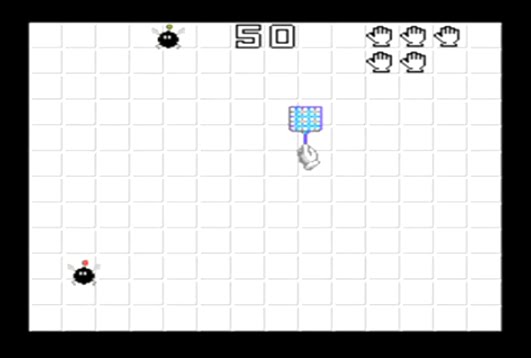
#50: Mario Paint
1992
Man, I loved this game when I was a kid. Today? Not so much. It was Nintendo's sad attempt at making a collection of “computer games” for the SNES, complete with its own mouse accessory. The game featured an art program, a music program, a make-your-own comic book and more! Though nice for its time, time has not been nice to it in return. The art program is so primitive, it makes Etch a Sketch look like Photoshop. The music program only allows you to create natural quarter notes, so anything “complicated” like sharps, flats and eight notes are way out of the question. So wait-wait-wait. How did this wrinkly old geezer of a game even manage to crack my list? Has nostalgia impaired my judgment? Is it just a “filler” to cap off my awkward list of forty-nine? Or is it simply one of those games I love to play on drugs? All answers are close, but it's actually secret option D: the fly-swatting mini-game. Buried under all the outdated modes is a mini-game so fun, it compensates for everything else – or at least serves as a nice distraction. You can find it by clicking that mysterious coffee mug icon on the menu bar. Now this game has survived the test of time. It's basically a first-person shooter, only instead of a cross-hair, you have a fly-swatter. Your goal is to defend a kitchen countertop from an army of insects. It's only three levels long, but the high difficulty and Arcadian addictivitis will keep you up all night trying to beat it. I got wicked good at it, especially after I turned up the mouse speed to the max and got a little buzzed myself.

#49: Wild Guns
1994/95
The Good, The Bad and the Robotic collide in this steampunk, western shoot-em-up. I don't generally care for shumps, but even I loved this one. You and a friend can play as “Clint” (modeled after Clint Eastwood's iconic rolls in Sergio Leone's spaghetti western films) and/or “Annie” (based on real-life bankrobber Annie Oakley). And trust me, you have to play this with a friend. Not only because of the brutal difficulty; it's the best co-op action game since Contra. In fact, the game is very similar to Contra's pseudo-3D levels. It's a fixed third-person shooter in which you're confined to the foreground shooting at enemies in the background. The game has a classic western setting -- you know, saloons, deserts, speeding trains and the like, but the enemies are all futuristic: giant robots, cyborgs with jetpacks, and even the robotic cowboys from The Nightmare Before Christmas! There's never any explanation for why futuristic things are invading the 1800's, but who cares? Steampunk rocks. Never heard of it? Watch this. You start Wild Guns with only a machine gun and lasso, but you can also acquire a shotgun, grenade launcher and dynamite. You can dodge bullets Matrix-style, but real men will intercept them with a bullet of their own! The more incoming enemy bullets you intercept, the more that mysterious gauge fills at the bottom of the screen. Once it's full, you unleash the almighty VULCAN CANNON, which will make even the toughest enemy robots look like R.O.B. This game ain't no trolley ride. It'll whoop yer ass good, partner. But it's only six levels long, and the infinite continues keep the frustration from outweighing the fun. My only complaint: where are all the Indians? Perhaps they're the ones building all the evil robots.
 #48: Star Fox:
1993

#47: Pilotwings1990/91
Pilotwings will make you repeatedly glance down at your controller to prove you're not playing an N64 game. The 3D effects are that good. In fact, I think this is a far better game than Pilotwings 64. It's a flight sim where you play as a young pilot trying to earn your flying license. To do so, you must pass a variety of aeronautical tests. You learn how to fly a plane, a hang glider, a jetpack and even go skydiving. The game is pretty tough but never overwhelming because your instructors give you a lot of leeway. See, every lesson is graded out of 100 points, but each stage of the game only requires you to score a designated total between all of the lessons. For example, one stage of the game requires you to score 220 points between three different lessons, meaning you can totally bomb the biplane lesson and still pass the class if you score high enough on the skydiving and jetpack lessons. And if you're slick enough to land on the moving platforms in any of the tests, you're treated to goofy bonus rounds where you can earn extra points as an angel bouncing on trampolines or a skydiving penguin. The best part of the game comes when you finally earn your gold license: you’re suddenly called into battle with a heavily-armed helicopter in an illegal rescue mission. Pilotwings was one of the very first titles on the SNES, yet I think it had some of the most advanced graphics and gameplay the system has to offer.
1993
 #45: F-Zero
1990/91
If you can read this, it's definitely not a bumper sticker on an F-Zero hovercraft. This is one of the fastest frickin' racing games you'll ever play. I gotta admit, F-Zero is an awesome game but an awful title. It sounds like the worst grade you could possibly receive on a homework assignment. On the contrary, I'd give this game an A-95. It was the first great racing game, and it's still one of the best. It was also the other launch title on the SNES (along with Super Mario World). Mode 7 gave the game its groundbreaking 3D capabilities (later seen in Star Fox and Pilotwings), and despite how incredibly fast the game is, both the graphics are controls are smooth as silk. There are four different hovercrafts, fifteen tracks and four difficulty levels, giving the game plenty of replay value. I particularly like how you can see each crafts' stats on the selection screen. The four racers are very well-designed. The two with high acceleration have lower top speeds, and the ones with low acceleration have higher top speeds. Therefor, the Blue Falcon is great for beginners. The Golden Fox and Wild Goose are harder to use, but once mastered, are even better. And the Fire Stingray is always the best, but only in the hands of a pro like myself. Every lap you complete awards you with a mushroom, er, I mean, a power-boost. Other than that, there aren't any weapons like in Mario Kart, but you can damage other racers by crashing into them, or repair your own racer by flying over power-beams in the pit areas. The fast, techno soundtrack fits the futuristic theme perfectly. But this game has one major flaw: it suffers from a mysterious lack of multi-player.

 #43: SimCity
1991
 #42: Final Fantasy V
1992/1999

A) In feudal Japan, a ninja must infiltrate an enemy castle and assassinate its lord. You can choose whether to be stealthy and avoid all the battles or simply slaughter everyone in sight. If you take the kill-everyone approach, the game tallies the body count, and only by slaying all one hundred of the residents can you earn a powerful katana. But the stealthy approach is far more fun, especially since you start with an invisibility cloak which you can use anytime outside of battle.
C) In the far future, you play as a robot aboard a spaceship returning to Earth with a mysterious new lifeform aboard. It bears so many similarities to the film Alien, I can't believe the game didn't start a lawsuit. This one's an effin' horror game! Once the creature gets loose on the ship, the game becomes terrifying, as you must sneak through the ship without getting caught by the beast, which could be lurking right around any corner.
G) In the near future, a teenage punk with psychic powers must defend his city from a gang of streetpunks and a corrupt corporate entity. In addition to speaking to people normally, you can also read their minds to learn important secrets or hear some dirty comic relief.
After completing each of the seven seemingly-unrelated stories, you unlock the final final two chapters, which tie them all together in a powerful, totally unpredictable way. Oersted may very well be my favorite videogame villain of all time. You get to make a big decision toward the end of the game, which leads to two different endings. The game's battle system is as unique as the story. Battles play out on a grid-based arena, kind of like a simplified version of Final Fantasy Tactics. You have a guaranteed chance of running from random battles (which was especially helpful in that damned prehistoric chapter), and after every battle, your characters all get a full-cure! I can't believe Live a Live wasn't released outside of Japan, as it has some terrific production values. In fact, I think the story and characterization is so good, I would love to see it remade today with fancy cutscenes and talented voice actors. That's right, I dig modern games, too. Most of the time I'm just overcompensating to get younguns into the oldies.
The Good, The Bad and the Robotic collide in this steampunk, western shoot-em-up. I don't generally care for shumps, but even I loved this one. You and a friend can play as “Clint” (modeled after Clint Eastwood's iconic rolls in Sergio Leone's spaghetti western films) and/or “Annie” (based on real-life bankrobber Annie Oakley). And trust me, you have to play this with a friend. Not only because of the brutal difficulty; it's the best co-op action game since Contra. In fact, the game is very similar to Contra's pseudo-3D levels. It's a fixed third-person shooter in which you're confined to the foreground shooting at enemies in the background. The game has a classic western setting -- you know, saloons, deserts, speeding trains and the like, but the enemies are all futuristic: giant robots, cyborgs with jetpacks, and even the robotic cowboys from The Nightmare Before Christmas! There's never any explanation for why futuristic things are invading the 1800's, but who cares? Steampunk rocks. Never heard of it? Watch this. You start Wild Guns with only a machine gun and lasso, but you can also acquire a shotgun, grenade launcher and dynamite. You can dodge bullets Matrix-style, but real men will intercept them with a bullet of their own! The more incoming enemy bullets you intercept, the more that mysterious gauge fills at the bottom of the screen. Once it's full, you unleash the almighty VULCAN CANNON, which will make even the toughest enemy robots look like R.O.B. This game ain't no trolley ride. It'll whoop yer ass good, partner. But it's only six levels long, and the infinite continues keep the frustration from outweighing the fun. My only complaint: where are all the Indians? Perhaps they're the ones building all the evil robots.

1993
They may look like paper airplanes today, but when I was a kid, those Arwings were the sexiest things I had ever seen! And although the game's graphics are outdated today, the gameplay is not. In this classic rail shooter, you’re Fox McCloud, a mercenary fighter pilot hired to save the animal galaxy from the evil Andross (a total Dr. Zaius wanabe). This means flying across the galaxy, planet to planet, and blowing up everything along the way. Nintendo installed Super FX chips into all the Star Fox cartridges to allow for the game's enchanced, 3D graphics, which were not only way ahead of their time, but they still have a unique charm today. With multiple routes to chose from, a nice mix of space and surface missions, great boss battles and a kickass soundtrack, this dogfighter made me wanna join in the air force… until I grew up and found out you can’t really fly a jet into outer space. The only reason this game ranked so low is because it was practically eclipsed by superior sequels. But we'll get into those later (maybe even within this countdown). Like many of Nintendo's series, the original Star Fox feels a bit like a rough draft compared to its sequels. I would argue that that Zelda III and Metroid III totally replaced their predecessors. However, the original Star Fox still holds up surprisingly well, and it has some great stuff you won't see anywhere else in the series, like some wonderful techno music and trippy cut-scenes. Another thing I prefer in this version was Slippy, who was much cooler here than he ever was in, say, Star Fox 64. Apparently this was before he got the sex-change. This is also one of my favorite games to play while intoxicated. All those colorful, moving shapes are absolutely mind-blowing, especially in the level Space Armada. “Whoa, duuuude. Check out those gnarly polygons!”

#47: Pilotwings
Pilotwings will make you repeatedly glance down at your controller to prove you're not playing an N64 game. The 3D effects are that good. In fact, I think this is a far better game than Pilotwings 64. It's a flight sim where you play as a young pilot trying to earn your flying license. To do so, you must pass a variety of aeronautical tests. You learn how to fly a plane, a hang glider, a jetpack and even go skydiving. The game is pretty tough but never overwhelming because your instructors give you a lot of leeway. See, every lesson is graded out of 100 points, but each stage of the game only requires you to score a designated total between all of the lessons. For example, one stage of the game requires you to score 220 points between three different lessons, meaning you can totally bomb the biplane lesson and still pass the class if you score high enough on the skydiving and jetpack lessons. And if you're slick enough to land on the moving platforms in any of the tests, you're treated to goofy bonus rounds where you can earn extra points as an angel bouncing on trampolines or a skydiving penguin. The best part of the game comes when you finally earn your gold license: you’re suddenly called into battle with a heavily-armed helicopter in an illegal rescue mission. Pilotwings was one of the very first titles on the SNES, yet I think it had some of the most advanced graphics and gameplay the system has to offer.
1993

Apocalypse! The world is being invaded by every classic Hollywood horror monster: vampires, werewolves, martians, mad scientists, black lagoon creatures, mummies, Frankenstein's monsters, possessed dolls, chainsaw maniacs, and of course, zombies. You play as a ballsy young punk named Zeke wearing 50's-style 3D glasses who decides to save his neighborhood from the ghouls with an array of quirky weapons: squirt-guns filled with holy water, Popsicles, weed-whackers, shook-up pop cans that explode on impact, silverware, crucifixes and bazookas from fallen army-men. This game is a a scream! It's like playing through a cheesy old B-movie complete with a zany theremin soundtrack and a Twilight Zone-esque title screen. Zombies was also one of many great of examples of a game that was released on both the SNES and the Sega Genesis, and whose former version was vastly superior to the latter. In the SNES version, you can toggle a radar on and off to indicate the remaining neighbor's locations throughout the level. In the Genesis version, however, the radar is always on, and it not only hogs one-third of the screen, it hogs the right edge, meaning, if there's an enemy to your right, you're not gonna know about it until it's too late. But that's just the beginning. Get this: the SNES controller had four face buttons, which was perfect for a game like Zombies. B toggled weapons; Y fired the weapon. A toggled items; X used the item. The Sega controller, on the other hand, only had three face buttons, which proved disastrous: A fired the weapon, B also fired the weapon for some reason and C used the item. To swap weapons, you have to press A and B simultaneously, which often resulted in a weapon misfire. But worst of all, you can NOT toggle items in the Sega version!!! I can't even begin to express how much this ruins the game. Just imagine you reach a locked door in a level. To unlock it, you need to have a key selected in your item display. So, if you happen to have your first aid kits selected instead, you'll have to waste every one of them just to gain access to the damned key. And heaven forbid you have a key selected when there aren't any locked doors left in the level, as that prohibits you from using first aid kits. I hate Sonic and I hate Sega. No wonder the SNES won the 16-bit wars.

1990/91
If you can read this, it's definitely not a bumper sticker on an F-Zero hovercraft. This is one of the fastest frickin' racing games you'll ever play. I gotta admit, F-Zero is an awesome game but an awful title. It sounds like the worst grade you could possibly receive on a homework assignment. On the contrary, I'd give this game an A-95. It was the first great racing game, and it's still one of the best. It was also the other launch title on the SNES (along with Super Mario World). Mode 7 gave the game its groundbreaking 3D capabilities (later seen in Star Fox and Pilotwings), and despite how incredibly fast the game is, both the graphics are controls are smooth as silk. There are four different hovercrafts, fifteen tracks and four difficulty levels, giving the game plenty of replay value. I particularly like how you can see each crafts' stats on the selection screen. The four racers are very well-designed. The two with high acceleration have lower top speeds, and the ones with low acceleration have higher top speeds. Therefor, the Blue Falcon is great for beginners. The Golden Fox and Wild Goose are harder to use, but once mastered, are even better. And the Fire Stingray is always the best, but only in the hands of a pro like myself. Every lap you complete awards you with a mushroom, er, I mean, a power-boost. Other than that, there aren't any weapons like in Mario Kart, but you can damage other racers by crashing into them, or repair your own racer by flying over power-beams in the pit areas. The fast, techno soundtrack fits the futuristic theme perfectly. But this game has one major flaw: it suffers from a mysterious lack of multi-player.
#44: Super Castlevania IV
1991All the great NES franchises got an even greater reboot on the SNES. Castlevania IV was so great, they even put a “Super” in front of it – a title it definitely deserves. The Drac is back and it's up to the next descendant of the Belmont family to stop him. Simon Belmont returns with his trusty whip, and this time, he's got some new moves. In addition to whipping in any of eight directions, you can now swing the whip around freely (like Sheik’s over+B in Melee), hold it upright to shield projectiles, or even pull an Indiana Jones and use it as a grappling hook. All the old secondary weapons are back, too: throwing knives, axes, and the amazing crucifix-ninja-star-boomerangs! Castlevanias always excelled in creating a horror-style atmosphere, but Castle IV just took everything to a whole new level. The series had always been set in medieval Transylvania, but Castle IV was so dark, it made the earlier games look like Kirby games. The soundtracks were always a mix of dark, dissonant classical and heavy death metal, but Castle IV's soundtrack is so hardcore, it made the earlier scores sound like boybands. The boss battles are so hard, they made the earlier bosses feel like goombas. This game is so gothic, it makes the earlier games look like a bunch of emo posers. There are even some Mode 7 effects, like a cylindrical background that rotates around you like you're in a haunted funhouse. This game kicks ass! Mainly your own, though. That seemed to be a common theme in the first tier of my countdown: difficult games, which means you really have to be in the mood for a good challenge to play them. But he who hath the balls shan't be disappointed!

1991
Perhaps the most original game ever made for its time, SimCity had no hero, no villains and no princess. It was the revolutionary building-simulation game that cast you as the mayor of a new city that you get to build from the ground up. It was originally a computer game in 1989, which would normally disqualify it for this list. However, the SNES “port” is actually a remake featuring many significant improvements including “gift” buildings (police headquarters, casinos, amusement parks), the ability to create disasters (tornadoes, plane crashes, Bowser), city classifications based on your population (town, city, capital) and a helpful hint-giver named after the game’s creator, Dr. Wright. Houses, buildings, factories, airports, stadiums, parks, roads, railroads... you get to build them all wherever you want, and how you place them in relation to each other will affect your population. The more people you attract, the more your city will upgrade. The game’s poignant soundtrack upgrades along with your city. It begins as a quiet, peaceful tune -- perfect for a small, rural town. Then as your city becomes more urbanized, the same song gets busier and heavier. It's all variations on the same theme, but by the time you get a Metropolis, you won’t even recognize the song anymore. You can also check your ratings, demographics and even change taxes. The only flaw with this game is that it starts you off with so little money that it's not even fun. You'll go broke in no time with only a small corner of your map colonized. But if you use the popular “million dollar cheat,” you'll have more than enough money to cover the entire map, which is how the game’s default should have been. Back when I was a kid, I tricked my little sister into thinking that your city continued to grow and shrink even while the game was off. That way, after she fell asleep, I could open her file and set Bowser loose on her city. The following day, she'd turn the game on to find her precious city reduced to rubble, and I'd say “there must have been a tornado.” I never confessed the truth to her until just now. Sorry, sis.
1992/1999
FFV wasn't originally released in the U.S., because at the time, it was considered far too difficult for us dimwitted American gamers. Thanks, Japan. For years, this game was only available on the Super Famicom (Japan's SNES), until finally, seven years later, it got a translated port on the PlayStation collection, Final Fantasy Anthology. I thought, surely the game can't be that complicated. I was wrong. FFV boasted a complex job system, a deep battle system and insanely hard boss battles. Like FFIII, you get four characters, each of whom you can change into any job class at any time, and each can borrow one special ability from another class. This gives you an endless amount of freedom for customization, a feature later seen in Final Fantasy Tactics. You can create anything from a “knight” with “white magic” (a.k.a. Paladin) to a “white mage” with “back attack” (a.k.a. Pope). There are twenty-two job classes, almost all of which I found useful sooner or later. My favorites were Hunter, expert archers that, once mastered, could fire four fast attacks in a single turn, Blue Mages, who could learn enemy skills once cast upon them, and the Trainer, which lets you take control over enemy monsters – which, by the way, is the only way to cast some of the best enemy skills on a fellow blue mage. The tricky boss battles often require some trial and error. You need to learn those bossy bastards by heart before devising a way to defeat them. For example, one of the hardest battle in the game pitted you against four crystals that would unleash MASSIVE damage to your entire party... but only after you've depleted over half their hit points. SPOILER: The trick I finally came up with to beating them involved turning all four of my characters to Summoners, turning the battle speed way down in the configuration menu, setting the cursor to memory, carefully depleting just under half of the crystals’ hit points, waiting until all four of my characters’ ATB gauges were full, then holding the confirm button down as if my life depended on it to quickly unleash four fast Titan summons in succession, destroying the crystals before they even got a chance to fight back. Sound too complex for you? Go play your Madden games, dimwits.

#41: Live a Live
1994/2001 (unofficial translation)Of all the RPG's that were never released in the U.S. (and believe me, I've played them all), this was the crown jewel. The only way to play it today is learn Japanese and purchase a Super Famicom along with the Japanese version of the game and a compatible TV to play it on. Or... you could simply download an SNES emulator and an unofficial fan-translated rom hack of the game. But don't tell 'em I sent ya, cuz emulation is kind of illegal. The opening screen of Live a Live presents you with seven chapters. Each follow a different character through a different time period. One by one, you must complete each of these chapters in the order of your choosing:
A) In feudal Japan, a ninja must infiltrate an enemy castle and assassinate its lord. You can choose whether to be stealthy and avoid all the battles or simply slaughter everyone in sight. If you take the kill-everyone approach, the game tallies the body count, and only by slaying all one hundred of the residents can you earn a powerful katana. But the stealthy approach is far more fun, especially since you start with an invisibility cloak which you can use anytime outside of battle.
B) In ancient China, an aging martial arts master must find a disciple to pass on his family's secret techniques. You get to choose which of three younguns to train as your disciple. Who and how you train them becomes of utmost importance at the chapter's climax.
C) In the far future, you play as a robot aboard a spaceship returning to Earth with a mysterious new lifeform aboard. It bears so many similarities to the film Alien, I can't believe the game didn't start a lawsuit. This one's an effin' horror game! Once the creature gets loose on the ship, the game becomes terrifying, as you must sneak through the ship without getting caught by the beast, which could be lurking right around any corner.
D) In the modern day, a martial artist enters a fighting tournament. It's like Mega Man, RPG-style. You fight six battles in the order of your choosing, and you learn your opponent's special moves as you defeat them.
E) In the old west, a cowboy joins forces with an old rival in order to protect a town from a horde of bandits who got their hands on a fancy new weapon called the gattling gun. Before the clock reaches high noon, you must gather supplies and prepare traps for the bandits, like explosives and ambushes. Oh, and restorative items include cigars, tequila and bourbon.
F) In the prehistoric age, a caveman fights for survival against a rival clan and carnivorous dinosaurs. This one's interesting in that it has no dialogue (as it's set before the advent of language). You also have a heightened sense of smell that allows you to sense things invisible to the player, a cool feature I'm surprised you don't see more often in games.
G) In the near future, a teenage punk with psychic powers must defend his city from a gang of streetpunks and a corrupt corporate entity. In addition to speaking to people normally, you can also read their minds to learn important secrets or hear some dirty comic relief.
After completing each of the seven seemingly-unrelated stories, you unlock the final final two chapters, which tie them all together in a powerful, totally unpredictable way. Oersted may very well be my favorite videogame villain of all time. You get to make a big decision toward the end of the game, which leads to two different endings. The game's battle system is as unique as the story. Battles play out on a grid-based arena, kind of like a simplified version of Final Fantasy Tactics. You have a guaranteed chance of running from random battles (which was especially helpful in that damned prehistoric chapter), and after every battle, your characters all get a full-cure! I can't believe Live a Live wasn't released outside of Japan, as it has some terrific production values. In fact, I think the story and characterization is so good, I would love to see it remade today with fancy cutscenes and talented voice actors. That's right, I dig modern games, too. Most of the time I'm just overcompensating to get younguns into the oldies.
And my SNES is just getting warmed up. Here's Part 2.