Wednesday, August 4, 2010

Top 50 Old Movies: Part 4


#20: Harold and Maude
1971

Forget Romeo and Juliet. Harold and Maude gets my vote for the greatest tragic love story of all time. Harold is a nineteen-year-old emo obsessed with death; he stages theatrical suicides for attention, attends the funerals of strangers for fun, and he drives a hearse. Maude is a 79-year old eccentric obsessed with life; she loves music, art, nature, inventing, and breaking the law. What starts as an unusual buddy film becomes an even more unusual love story. H&M is a deliberately offensive film that throws the finger at societal norms, intentionally appalling the faint of heart and closed of mind. But it’s also an unusually quiet film. Harold’s decisions are constantly belittled by the adult figures in his life, yet he never offers so much as a defense for his actions. And somehow, his silence speaks louder than any monologue on how “love knows no age” ever could. About halfway through the film, there’s a shot that only lasts for one second: a close-up of a barcode tattoo on Maude’s arm, a mark given to concentration camp prisoners in the holocaust. It’s a powerful image that explains everything about her character and adds a whole new layer to the story -- all done without a single word. Cat Stevens provides an uplifting soundtrack, with a mix of previously written hits and originals, including the wonderful theme song, “If You Want to Sing Out, Sing Out.” The few who didn’t walk out of the theater were rewarded with one of the greatest endings ever put on film: a miraculously moving montage that covers a passage of time in a chaotic, scrambled order while Stevens’ beautiful ballad “Trouble” wails along. Heartfelt, hilarious and mind-opening, this is definitely one of those “love it or hate it” films, and you’ll probably have to be at least a quarter emo to love it.


#19: Amadeus
1984

In reality, the prodigal Wolfgang Amadeus Mozart mysteriously died at the age of 35. This fictionalized biopic poses a possible explanation: what if he was murdered by a rival composer? Told from the villain’s perspective, Amadeus tells both the story of Mozart’s life and success, as well as his "assassin" Salieri’s jealousy and loss of faith. Music buffs take note. This is a film about composers for composers. Mozart was truly a genius, and this film really does him justice. You get to hear all his “greatest hits,” learn all the stunning facts and see the amazing methods behind his composing. It’s a shame Mozart wasn’t born two-hundred years later. He would have been a millionaire and the most popular celebrity in the world. But back in the eighteenth century, there were no LP’s, no CD’s and no MTV. Concerts were a good temporary source of income, but the bulk of a classical composer’s income came from teaching pupils, which Mozart had no patience for. All he wasted to do was compose… and party. Mozart was incredibly talented yet incredibly reckless. He was history’s first rockstar. Despite creative liberties made in the story, the film is a great biography, as well as a fabulous period piece. It was shot in the city of Prague, which, thanks to the Communist government, looks nearly identical to how it did in the 1700’s. The period set designs, costumes and makeup are all top-notch. It took four hours to apply the “old Salieri” makeup to F. Murray Abraham. This is also a great film for agnostics/atheists. It aims a lot of critical questions at religion. Normally, churches are very reluctant to let you shoot anything sacrilegious inside them, but since the Prague communists were all atheists, they were happy to comply. My only criticism of the film is the title. Why “Amadeus” over “Wolfgang” or “Mozart?” What’s next, a biopic on Ludwig van Beethoven called “van?”


#18: The Jungle Book
1967

The last film personally supervised by Walt Disney was also his best. Bagheera the panther discovers Mowgli, a mancub left in the wild, and delivers him to a pack of wolves (to be raised, not eaten). Ten years later, a man-eating tiger, Shere Khan, returns to their end of the jungle, which prompts the wolfpack to order Mowgli be escorted back to the man village. I love movies like this: there’s a simple premise in the beginning, and the rest is just full of episodic obstacles. It has a really fun freedom to it, like a Star Wars or Indiana Jones film. The rich animation hasn’t aged a bit. I love how in these old animated films, you can differentiate cells from the backgrounds, anticipating which objects are going to move within the shot. But even better than the visuals are the songs. Oh, baby, what a soundtrack! Who woulda thought the Indian jungle had such swingin’ jazz?! En route to the man village, Mowgli boogies with Baloo, a carefree bear, Kaa, a hypnotic python, a parade of war elephants, a vulture quartet who take after the Beatles, and (my favorite), King Louie, an ape who wants to evolve into a human. The menacing Shere Khan is only spoken of until the third act, which builds him a great reputation, and also serves as a looming threat behind all the fun. It all comes together with a trademark Disney silly-yet-serious action sequence, followed by a very clever ending. Sadly, Walt pulled a Bruce Lee and died during production. At least they both went out on top.


#17: Apocalypse Now
1979

Apocalypse now: the motto of a group who believe technology has come too far and dream of starting over. Consider me one of them; I believe a society that’s created the power to destroy their own planet deserves just that. The story follows Captain Willard, a special ops soldier obsessed with war. In return for his great accomplishments in Vietnam, the army offers Willard anything he wishes. All he asks for is another mission. Boy, does he get it. He’s hired to assassinate Colonel Kurtz, a renegade U.S. soldier who’s gone “completely insane” and formed an alliance with the Viet Cong in the Cambodian jungle. But as Willard journeys up the Nung river to find him, he begins to wonder if it’s Kurtz who’s gone insane… or the American army. The intrigue and anticipation surrounding Kurtz is fantastic. We only see pictures of him and hear a recording of his voice. When we finally meet Kurtz, we see him on only teasing glimpses of light. He’s often regarded as one of film’s most interesting characters -- an enlightened man full of insight and wisdom. But I actually found Willard even more interesting: a cold, distant and troubled man who gets a rude awakening. The poetic screenplay really depicts the horrors of war, and Coppola’s direction gives the film an eerie, nightmarish vibe that makes you feel a bit crazy yourself… or is it enlightenment? Apocalypse Now is, hands down, the greatest anti-war film of all time. In fact, it’s such an anti-war film that it doesn’t even culminate with a big battle scene. A conventional ending would have Willard teaming up with Kurtz to defend his Buddhist temple against Kilgore’s awesome helicopter assault. But instead, what we get is a symbolic, anticlimactic ending that’s bound to leave the average moviegoer mystified.


#16: Willy Wonka & The Chocolate Factory
1971

Yum. Just thinking about this movie gives me a sweet tooth. International frenzy erupts when Willy Wonka, the world’s most enigmatic candy man, hides five golden tickets in his Wonka bars, announcing that five lucky winners will win a chance to tour his magical factory, a lifetime supply of chocolate, and a special surprise. All the kids turn out to be spoiled, rotten brats, except for a kind boy named Charlie. This was the Wizard of Oz of the 70’s: a colorful musical-fantasy for audiences of all ages. But if you ask me, the Oompa Loompas could kick the Munchkins’ asses any day! Underneath the edible imagery and catchy songs, the film is actually very sick and twisted. Wonka is, in essence, a sadistic murderer who preys on the weaknesses of the children. He remains careless and calm while the selfish, naughty children systematically succumb to bizarre and tragicomic fates. His factory is a world of its own, full of wonderful things like a chocolate river and fantastic inventions, as well as terrible things like a horror ride and dangerous temptations. It’s all very Seussian, complete with Gene Wilder as the “cat in the hat.” The songs are great, especially "Pure Imagination." My only complaint is that Charlie never gets a turn at the mic. His mom has a song, his grandpa has a song, his local candyman has a song, Wonka has a song, the Oompa Loompas have songs; even one of the other kids has a song, but for some blimey reason, they didn’t bother to give a song to the protagonist! What gives? Other than that, Willy Wonka a scrumdiddlyumtious film that always leaves me in a great mood. And it’s infinitely better than Tim Burton’s version. Why does he keep remaking films that were already classics?! Oh, right, because that's what every director does nowadays.


#15: North by Northwest
1959

This was like the original Bond film, predating Dr. No by three years. And no offense, James, but none of your twenty-some missions have retrieved anything as valuable as NxNW. Cary Grant stars as Roger Thornhill, an ordinary insurance salesman that gets swept into deadly spy games due to a case of mistaken identity. Before he knows it, he’s on the run from spies (who think he’s a government agent), and the government (who thinks he’s a spy). Thornhill himself is a lot like Bond, a wisecracking, smooth-talking counterspy. James Mason plays the theatrical villain, Martin Landau is his cold but feminine henchman, and the gorgeous Eva Marie Saint plays the babe-a-licious blonde Thornhill meets on a train. Screenwriter Ernest Lehman spins a terrific mystery full of great twists, lovably cheesy romance and thrilling tension. Hitchcock was truly the master of suspense, and this film was his best! There’s a creative car chase in which our hero has no choice but to drive drunk in order to escape his would-be assassins. Later, the badguys attempt to off Thornhill from a biplane Kong-style. My favorite part was a ninja-like infiltration into the villain’s posh, mountaintop house, including the most intense “edge of your seat” moment ever put on film! And of course, the film ends with a famous mountain-climbing chase across the faces of Mt. Rushmore. Hitch storyboarded every shot before production, he had a great eye for cinematic storytelling, and he was quite daring. When denied permission to shoot at the United Nations, he disguised the film truck as an icecream truck and shot the desired footage from across the street anyway. When denied permission to film at the real Mt. Rushmore (apparently, staging murders on the presidents’ faces was deemed too offensive), Hitch constructed his own faces out of replicas and enormous paintings. He even snuck some sexual symbolism into the film’s final shot that the censors didn’t catch. The tension is heightened by an amazing score by Bernard Herrmann. As much as I love the film, it has another one of those titles I don't care for. “North by northwest” isn’t even a real compass direction. Although it would be an easy title to draw in Pictionary...


#14: Back to the Future
1985

Great scott! This is heavy: Marty McFly is your average guitar-shredding, skateboarding teenager living in 1985 until the mad scientist, Doc Brown, accidentally sends him back to 1955 (in a souped up, time-traveling DeLorean, no less). As if being stuck in the past isn’t bad enough, Marty runs into his parents when they were in high school, and inadvertently gets his own mother to fall for him instead of his dad, threatening to erase his very existence. This sci-fi-high-school-adventure-comedy is not only endlessly entertaining, it’s one of the greatest screenplays ever written. Every single little itty-bitty thing becomes important later on. It’s full of what us writers call “plants” and “payoffs,” many of which you won’t even notice the first viewing. The whole mother-son infatuation sounds grodey, and it was the reason Disney refused to back the picture, but director Robert Zemeckis executes it so well that the attraction comes off as comical and suspenseful instead of tasteless. The dialogue is priceless, especially the doc’s techno-babble -- who doesn’t know how many gigawatts of electricity the flux capacitor needs to break the time barrier? I can’t imagine anyone playing the leads beside Michael J. Fox and Christopher Lloyd. Fox is such a likable, believable teenager, and Lloyd gives the most delightfully over-the-top performance since Gloria Swanson in Sunset Boulevard. But it’s easy to forget how good the supporting cast is. Lea Thomson and Crispin Glover excel as Marty’s parents (in both ‘85 and ‘55), and seeing them in the past after seeing them in the present really is like seeing your own parents back when they were in high school. Last and least, there’s Biff, the big, buttheaded bully, who was voted the #1 “baddest bad guy” by one of my favorite fellow film critics, James Rolfe. BTTF is one of the all-time great sci-fi films, and there’s hardly even any CG in it. But it’s full of that good old-fashioned movie magic. Through great storytelling, a little makeup and those wonderfully mysterious musical cues, the film evokes more awe and wonder than special effects can. If you’re one of the few people on the planet that somehow haven’t seen this one, I’d say it’s about time.


#13: Little Shop of Horrors
1986

Little shop… little shoppa horrors! Little shop… little shoppa terror! Bob sh’bop, doo-wop a-scooby-dooby du-bop! Ahem. Sorry. I adore musicals, and this is one of my all-time favorites! It’s a campy, rock ‘n roll monster-movie-musical-comedy about a flower shop on the verge of bankruptcy until a nerdy employee, Seymour, discovers a “strange and unusual new plant,” which brings him fortune, fame, and the attention of his dream girl. But there’s one little catch: the plant feeds on blood. Little Shop is adapted from an off-Broadway musical play, which was adapted from a non-musical B-movie from 1960. The story went from the film to stage and back again, and in the process grew into something amazing. The 50’s-style songs were written by Alan Menken and Howard Ashman, who would later compose the soundtracks for many of the neo-Disney films, including The Little Mermaid, Beauty and the Beast and Aladdin. The Little Shop soundtrack may not be their most popular, but I actually think it’s their best. The songs are a thrill ride for the ears. It’s the kind of movie you’ll end up watching with a group who sings along with every song because they know all the lyrics. I love love-stories about a nerdy guy vying for a seemingly unattainable girl; they’re so inspirational. Rick Moranis is perfect as Seymour. He’s just so lovably nerdy. Ellen Greene was so good as Audrey in the stage version, she was cast as Audrey in the film, too. The supporting cast is filled with SNL stars, including Steve Martin as a demented, drill-happy dentist. But it’s the plant that steals the show. “Audrey II,” aka “Twoey,” is a marvel of movie monsters. The incredible, CG-like creature was actually an elaborate puppet (you won’t believe it), ran by up to forty puppeteers at once, all running levers beneath the set like frantic exercisers at a gym. Speaking of puppets, the film was directed by Frank Oz, better known as Yoda.


#12: Indiana Jones and the Temple of Doom
1984

This severely underrated prequel pits Indy against a Thuggee cult to rescue magical Sankara stones, with the help of a goofy Chinese sidekick and the hindrance of a ditzy blonde. The film features many scenes that were originally planned for Raiders, such as the swordfight (which Ford improvisationally bypassed by simply pulling his gun in Raiders), the daring escape from a doomed airplane and the infamous mine-cart chase that inspired those classic Donkey Kong levels. Now, this film has really a bad rep. It’s widely considered the black sheep of the trilogy, and I think I know why: it was too dark for most people. That’s probably why it’s my favorite. Temple is gross, gory, scary as hell, and it’s the only one that’s centered around a different mythology. Temple is all about dark magic, which probably isn’t as familiar and family-friendly as the Christianity seen in Raiders and Crusade. Instead of God and holy artifacts, there’s voodoo, curses and human sacrifice. The Temple itself is full of Hellish imagery. In my opinion, Temple had the only great villain on the series: the dark magician, Mola Ram. It also had my favorite sidekick, Short Round (played by the goofy Asian kid from The Goonies). Indy’s love interest, Willie, isn’t as cool as Marion Ravenwood or as hot as Elsa Schneider, but she’s definitely great comic relief. The action scenes are spectacular, typically featuring multiple conflicts that are dependent on each other. Indy uses his whip the most in this film, by far. If that isn’t cool enough for you, he also uses a sword on multiple occasions! The MPAA wanted to give Temple an “R” rating. In response, Spielberg argued there should be a rating between PG and R, and thus, Temple was the first film to receive the PG-13 rating.


#11: The Sting
1973

In this classic Disney film, bumblebees fight to reclaim their stolen honey from a pack of greedy bears... Sucker! It's really a documentary on the rock musician Gordon Sumner, aka "Sting." Psyche! See how easy it is to trick people? That’s what The Sting’s all about. It’s actually a heist film about two con artists (Robert Redford and Paul Newman) that plan an elaborate “sting” to get back at a rival crime boss (Robert Shaw). Along the way, they dodge hitmen, cops, and even the feds… but can they trust each other? I love heist films, and this is hands-down the best of the best. The heist is extremely complicated, yet easy to follow and a joy to watch unfold. The plot involves building a phony betting parlor from the ground up, casting dozens of conmen as actors, suspenseful complications, excellent chase scenes and the best card game ever put on film. As complex as it seems, pulling those kinda jobs were actually common in big cities during the Great Depression. The ragtime soundtrack single-handedly revived 30’s jazz, especially its theme song, "The Entertainer." Amazing period detail, great action scenes, classy jazz, old-fashioned title cards, and a phenomenal script are just a few of the reasons this crime caper stole 7 Oscars. It was made by the same cast and crew that made Butch Cassidy and the Sundance Kid, but in my opinion, that film’s gotten criminally overrated while its little brother’s been shortchanged. The characters pull all sorts of tricks on each other throughout the film, but the best ones are those played on the audience.


Up next: the thrilling conclusion! Click here for Part 5.

Friday, July 23, 2010

All I Really Need to Know I Learned in Final Fantasy


+Always buy protection.

+Remember to equip the protection before entering dungeons.

+Chicks dig sensitive guys.

+Animals are meant to be slaughtered.

+The best parties are those with four or five people.

+You're missing out bigtime if you don't get Star Wars references.

+Black, white, red, blue… get to know them all.

+Talk to everyone.

+All your loved ones will die.

+Everyone was born to master a different job.

+If your friends have long names, give them short nicknames.

+Experience outweighs gold.

+Wait your turn.

+Choose your battles.

+Learn from your enemies.

+Covet thy neighbors.

+Save your files frequently.

+You will not win on your first try.

+You will not win on your second try.

+You will win with perseverance.

Wednesday, July 21, 2010

Toy Story 3 Review


Toy Story 3
2010

Unplanned sequels are like unplanned pregnancies: most of them go unloved. That’s why I was afraid to see this movie. I was a huge fan of the original Toy Story. I was happily surprised with the second-born. Then a whopping eleven years passed. I was content with two Toy Stories. I didn't want another. But then Pixar got pregnant again. Toy Story 3 had such a huge age difference from its older brothers, I thought it would surely be aborted during pre-production or debut like a stillbirth at the box office. But Pixar was waiting for a reason. They didn’t follow the Hollywood trend of squeezing out another sequel as soon as the womb was fertile again. They held off until they were prepared with an amazing screenplay full of ideas as brilliant as its predecessors. The team may not have ever planned to make a third film, let alone a second, but now that it's here, I can't imagine how we ever went without it.

Woody and company haven’t been played with for years (I know how that feels). They desperately long for their owner's affection, but the child they fell in love with, Andy, is now a young man who lost interest in them long ago. As Andy packs for college, he intends to put the old toys in the attic, but a misunderstanding lands them at the Sunnyside Daycare Center. Their new home seems wonderful at first. The facility is beautiful, the staff is professional, and the toys get played with every day. But come nighttime, the daycare toys run it like a prison, led by an evil Lots-O-Huggin’ teddy bear. He, too, seems sweet and huggable at first, which immediately set off my built-in screenwriter's villain-detector. Sure enough, Lotso's rigged the system like a politician, forcing the new toys to endure rapelike playtime with toddlers in the “Caterpillar Room,” while Lotso and his cohorts enjoy orgasmic playtime with gradeschoolers in the “Butterfly Room.” Andy's toys resolve to escape the dreadful daycare center and return home before their owner leaves for college, despite the fact he doesn’t appear to care for them anymore.

No kid ever had a toy collection as cool as Andy's. And boy, are there a lot of them. I can’t think of a film that follows a larger ensemble of protagonists -- thirteen of them! Oh wait, there was Ocean's Thirteen... but "Andy's thirteen" are much more fun. Each member of the collective gets an equal share of the dialogue, jokes and important roles, as each of them have unique inherent abilities that come in handy during the delightfully over-elaborate escape -- Slinky Dog can stretch to great distances, and Mr. and Mrs. Potatoe Head have detachable, independently functional body parts. The writers really came up with some clever character-related concepts that I won't dare give away here. Joining the old toys are some welcome newcomers, my favorite being the hysterically metrosexual Ken Doll, who, of course, gets an instant Lincoln Log when he meets Barbie.

The story is great fun, accompanied by a wonderful soundtrack and Pixar's usual top-notch animation. My favorite part was the amazing climax, set in a landfill that makes the Temple of Doom look like Ken's Dreamhouse. The one section I disliked was when Buzz got reverted to his original, disillusioned state. I thought, not again... It was funny in the first film, and it worked in the second film when there were two Buzzes. But I couldn’t believe the writers resorted to the same old gag for a third time. Only minutes later, I found myself politely withdrawing my criticism, as the gag led to perhaps the funniest section of the film: attempting to fix Buzz, the others accidentally convert him to Spanish Buzz (think Antonio Banderas after a few shots of tequila).

Toy Story 3 was the greatest film made in what seems like lightyears, and it's my favorite of what is now one of my favorites trilogies. If you don't cry your eyes out during the ending, your batteries must be dead. These films are more than just children’s fantasies; they’re hilarious comedies, thrilling adventures and touching metaphorical dramas about love. They're the perfect films to watch if you're feeling heartbroken, because they do a great job of relating to your pain and an even better job of cheering you up. They inspire you to remain positive and courageous, because no matter how lonely and unwanted you feel, you will always find someone else who wants to play with you again. Thank you, Pixar. Thank you. 5/5 stars.

Wednesday, June 30, 2010

Top 50 Old Movies: Part 3


#30: The Godfather Part II
1974

This seldom-seen “equal sequel” was actually a sequel and a prequel to the first film. Whereas Part I depicted the golden ages of the mafia wars, Part II tells the rise and fall of the Corleone family. Robert DeNiro gives the best performance of his career as young Vito, believably creating a younger version of Marlon Brando’s legendary performance. It earned DeNiro an Academy Award -- the only time two different actors were honored for playing the same character. In the prequel section, Vito goes from a penniless, orphaned immigrant to a powerful, respectable crime lord, while in the sequel section, his son, Michael desperately tries to hold onto his father’s business despite assassination attempts, a federal investigation and a deteriorating marriage. It’s very well-done, showing how the father and son had reverse priorities. Vito only got into crime to support his family, whereas Michael only started a family to pass on the criminal empire. Michael doesn’t even love his wife; he clearly only views her as a necessary step toward acquiring sons. He was the hero of the first film, but now he’s the villain. The drama is so powerful in these films is because in every scenario, the audience can empathize with both sides. Yeah, murdering a woman or a child or your own brother sounds horrible, but hear the story out, and you'll at least understand their reasoning. Part II lacks the exciting pace of the original and the death scenes aren't as good (I was dying to see a sniper rifle kill), but it’s still amazing how well the film broadens the scope of the original and further develops the characters. It’s like an awesome expansion pack for those who already love Part I.


#29: The Treasure of the Sierra Madre
1948

What do you get when you mix western with noir? Gold! Set in the 1920’s, Treasure of the Sierra Madre follows three men that go gold-diggin’ in the Mexico mountains. There’s Dobbs, the kinda egg you just know is gonna go bad, Curtin, the lovable goody-goody, and Howard, the wise, experienced old timer. Harsh weather, stinkin’ banditos and Gila monsters are the least of their worries. Their biggest threat is each other. After striking it rich, Dobbs (Humphrey Bogart) descends into madness and paranoia, turning on the others to keep all the riches for himself. The excellent screenplay, based on the 1927 novel by the mysterious B. Traven, is the definitive story on greed. It has both the dark immorality of a noir and the heroic morality of a western, along with the brutal grittiness of both. The two genres actually have a lot in common; it’s a wonder there isn’t more “westernoir.” My favorite Simpsons episode, Three Men and a Comic Book, is a parody of this film. Rarely do you get to see the protagonist turn into the antagonist, and certainly never this well. There’s a lot of Spanish dialogue but never any subtitles. It’s a very interesting choice that really compliments the audience’s intelligence. We don't need to read a translation to understand the scene. The film is full of great foreshadowing, and it all comes together for a satisfying conclusion. The score is equally well-written. There are a number of great motifs, including one that alternates between major and minor keys depending on the mood. A true treasure of film history.


#28: Sunset Boulevard
1950

Fellow screenwriters, this is the movie for us! William Holden plays Joe Gillis, the iconic starving screenwriter trying desperately to break into Hollywood. One day, he has a chance meeting with Norma Desmond, an aging former star of the silent era, who’s planning a triumphant return to the screen with a script she’s written for herself to star in. Norma’s a loon, and her script is equally loony, but Joe cons her into hiring him to doctor the script until he can afford to get back on his feet. But the longer Joe stays with Norma in her crumbling, gothic mansion, the more tangled up he gets in her spidery web. Gloria Swanson is crazy-good as Norma, a disillusioned, forgotten has-been who still thinks she’s Queen. Just try to take your eyes off her for a second. You can tell she was once very beautiful, and her exaggerated performance perfectly suits the character of a silent actress. The screenplay is like, the Screenwriter’s Bible. It’s a perfect example of how to do everything right in a movie. Despite its traditional structure, the film is very unique. It’s narrated by a dead protagonist. The voice-overs are full of poetic wiseguy-speak. And of course, the most interesting thing about the film is that it’s a big Hollywood film that bashes Hollywood left and right! I’m still shocked that Paramount was so cool with it, especially in 1950. It depicts the film industry as a cruel underworld where producers rewrite scripts beyond all recognition, where good writing doesn’t put food on the table -- only garbage sells, and studios are like exclusive clubs that only admit members they can milk profit from, only to swiftly kick them out the moment they run dry. Sunset Blvd. is mandatory viewing for filmmakers, screenwriters and film buffs alike.


#27: White Heat
1949

The only porno to make the list! No, but the title sure sounds like it. James Cagney lights up the screen as Cody Jarett, a criminal mastermind, a fiery-tempered maniac, and a total mama’s boy. Following a successful train robbery, Cody confesses to a lesser crime to get easy jail time instead of the chair. But his “cellmate” is really an undercover cop trying to infiltrate his operation, and on the outside, his “righthand man” is taking control of his gang (and his woman). This fast-paced, violent powerhouse blew audiences away in 1949, and it’s just as hot today. In my opinion, Raoul Walsh is the most overlooked director, period -- nay, exclamation mark! His films are all decades ahead of their time, and White Heat is one of his best. It’s full of hardcore things you never see in old movies, as if Walsh went back in time just to mark new territory first. It’s that surprising level of badassism that makes the movie so explosive. Cody Jarett gets my vote for the greatest gangster of all time. He’s a walking inferno, destroying everyone and everything that comes between him and the “top of the world.” No wiseguy ever had better dialogue. “You wouldn’t kill me in cold blood, would you?” pleads a man who had tried and failed to murder Cody in prison. “Nah, I’ll let ya warm up a little,” growls Cody. Later, when the man is begging for air in the trunk of a car, Cody barks, “I’ll give ya a little air!” before firing several air holes into the trunk. I just love that kinda stuff. From the scorching opening to the fiery finale, this one’s a rapid burner that’s guaranteed to set your blood ablaze!


#26: The Gold Rush
1925

Charlie Chaplin played the same goofy bum in nearly all of his films, yet each story was totally original. His legacy was similar to Bugs Bunny's; a classic mascot always getting into comical, cartoony situations. In this “episode,” Chaplin goes to Yukon, Canada looking for gold, only to find himself in one hilarious sight gag after another. In one scene, Chaplin and his fellow prospectors wake to find their cabin teetering dangerously on the edge of a cliff. On the brink of starvation, they consider cannibalism (the origin of the “I’m so hungry, you dissolve into food” trick). While in town, Chaplin entertains some ladies by performing his infamous “dance of the dinner rolls.” I once made the mistake of having a snack while watching this film. I nearly choked to death laughing. Slapstick is by far my favorite kind of comedy, and Chaplin was unbelievably good at it. But what really made Chaplin’s films stand out above the other silent comedians was the emotion. His films were as sad as they were funny. There are some surprisingly deep scenes in The Gold Rush involving Chaplin’s one-way love for a saloon dancer, including the origin of the “thinking the girl is waving to you when she’s really waving to the guy behind you” joke. But after every heart-tugging scene is a good knee-slapper to cheer you right up again. As much as I adore Chaplin, I have to bash one thing about him. He was one of the first filmmakers to revisit one of his films years later to make alterations to it -- a terrible trend that directors continue to follow today. Chaplin reedited this one in 1942 and turned it into a talkie! What a disaster. Thankfully, the DVD comes with both versions. Watch the original. If you're into laughs, it’s a goldmine.


#25: City Lights
1931

I wasn’t going to include two Chaplin films for variety’s sake, let alone back to back, but I had to be honest. It was hard deciding between City Lights and The Gold Rush, as they’re both so great, so similar in style and so different in story. This time, Chaplin’s hobo hits the big city, where he falls in love with a blind flower girl who mistakes him for a millionaire. Naturally, he plays along to keep her interested. While keeping the farce alive, Chaplin scrambles to earn enough money to support her from various and hysterical oddjobs. But when a groundbreaking new surgery is announced that could restore her vision, Chaplin must choose between lying to keep the girl… or coming clean and risk losing her forever. By 1931, “Talkies” were all the buzz. The studios said silent films were dead, but Chaplin proved them all wrong by writing, directing, starring in, writing and composing the score for this gem that was voted the #1 greatest romantic comedy by the AFI. It’s full of great slapstick pieces, including a public unveiling of a new sculpture that Chaplin had been using as a bed, an attempt to rescue a drunk from committing suicide, and (my favorite) a boxing match in which Chaplin must face an opponent twice his size. The love story is my favorite ever told. Chaplin is just such a sweetheart. He taught me the importance being kind to the world, no matter how unkind it is to you. The film really showcases the magic of the silent era, when they only resorted to dialogue as a last resort, and as a result, every line is infused with tremendous effort and purpose. It's one of the only films to bring happy tears to my eyes.


#24: The Apartment
1960

Jack Lemmon is “Buddy boy” Baxter, a regular nine-to-fiver who’s discovered the secret to getting promotions: lending his apartment to his superiors for their extra-marital affairs. But the higher Baxter climbs up the ladder, corporate-wise, the lower he sinks, depression-wise, because the woman he desires most is the boss’s mistress. Despite being such an old film, I still think The Apartment is the most accurate and entertaining study on contemporary relationships. Billy Wilder is one of my favorite writer/directors. Three of his films made this list (the others being Double Indemnity and Sunset Boulevard), and The Apartment ranked highest. It’s a superb balance of drama and comedy -- a comical, cute and caring look at dark, dirty and depressing material. Wilder always creates interesting characters in even interestinger situations having the interestingest dialogue. The script is full of clever little twists, and there’s a running gag that’s worked its way into my everyday speech. The characters at the office have an inside joke: moving the subject to the end of the sentence, followed by the suffix “-wise.” For example, “That’s the way it crumbles, cookie-wise.” I drop jokes like that all the time but no one ever gets them. Set from November to New Year’s Eve, the film focuses on all the lonely characters instead of the cheery ones. It’s a great holiday film for those spending it alone. It’s a terrific dramedy, writing-wise, acting-wise, direction-wise, and otherwise-wise. It was also the last black-and-white film to win Best Picture. It was the end of it, era-wise!


#23: E.T. the Extra-Terrestrial
1982

He’s all alone in a strange world… until he meets an alien. A lonely boy named Elliot discovers an extra-terrestrial stranded on Earth. The two outsiders quickly become best friends, but “E.T.” can’t survive forever in the Earth’s climate, and a sinister government agency is bent on capturing him. This heartwarming children’s story is a joy for all ages. Filmed from low angles to match a child’s perspective, the film was even shot chronologically to illicit genuine emotion from the child actors, whose “performances” are so real that they’re hardly performances at all. Henry Thomas is excellent as Elliot, and Drew Barrymore makes her film debut as Elliot’s adorable little sister. But it’s the alien that steals the show. E.T. is one of the all-time greatest movie creatures. He's such a chill little dude, and I love all the different magic powers he has. Spielberg’s previous film, Close Encounters of the Third Kind, also dealt with the concept of alien visitors, though that was a film much more focused on the computer-graphics. E.T. also has amazing effects, but it focuses more on the characters, which is why I think it’s aged so much better. The film is as rich thematically as it is visually. Composer John Williams was a constant collaborator of Spielberg’s, and his score here is one of his best, featuring the unforgettable “flying bicycle” theme. The emotional finale music makes me cry every time. In fact, I teared up just watching a couple minutes of the film to capture a screenshot. But I cried even harder when I played the E.T. game on the Atari.


#22: One Flew Over the Cuckoo’s Nest
1975

“One flew east and one flew west, and one flew over the cuckoo’s nest,” goes a nursery rhyme by Mother Goose. Jack Nicholson ROCKS as R.P. “Mac” McMurphy, a criminal who fakes crazy to serve the remainder of his jail-time in an insane asylum. There, he meets Nurse Ratched, a sinister tyrant who enjoys psychologically torturing her patients. Mac inspires them to fight back. The rousing psychological warfare between Mac and Ratched is more entertaining than most epic battle scenes. Mac is one of my favorite protagonists. He’s just such a cool, funny rebel, you can’t help but look up to him. His cheerleading turns the nuthouse into a funhouse! Nurse Ratched is one of the great screen villains: a calm, quiet authoritarian who doesn’t even seem to realize what a quasi-fascist-bitch she is! She’s truly frustrating to watch. The asylum is full of lovable inmates, including the stuttering young Billy Bibbet, childish Charlie Cheswick, and the gigantic, deaf-mute Native American, Chief. I’d fake crazy just to hang out with those guys. Director Milos Forman always found perfect cast, down to the smallest supporting roles. In most films, it’s the protagonist who has the character arc. But here, Mac doesn’t change a note. He inspires the change in everyone else. Cuckoo’s Nest was the best punk film of the seventies; a powerful, funny, and inspiring film that, despite being set almost entirely in one location, had universal themes.


#21: Psycho
1960

WEET! WEET! WEET! screeched Bernard Herman’s violins during what is perhaps the most famous movie scene of all time. By the early sixties, there were a lot of trashy, low-budget, B-horror films. Alfred Hitchcock, on the other hand, was at the height of his A-game, fresh off a long line of critical and commercial hits. In a daring departure, Hitch decided to make a cheap horror film of his own, but to do it well. Psycho gave horror a good name. It begins like a noirish love story about a blonde who goes on the run after robbing her employer. One night, she checks into a motel, where she befriends the sweet, handsome young owner, Norman Bates. After a heart-to-heart with Norman, the blonde decides to go home and return the stolen money. But then, the film suddenly takes a dark, shocking turn, becoming a terrifying murder-mystery. Young audiences may not understand just how innovative Psycho was for its time. It practically invented all the horror elements that are clichés today, and it sent audiences running for the exit. In fact, many theater-goers of the time were accustomed to entering and leaving movies whenever they pleased, an idea I can’t even begin to understand. What, were couples just using theaters to mack?! I had a babe try that once. She got all pissy when I rejected her -- that’s the ultimate test of film geekage. Hitchcock actually convinced Paramount to convince theater managers not to admit anyone after the show started, which led to long, angry, horny lines in the streets. But Psycho is one of those films you had to see from start to finish. It was the first film to hide a humongo secret until the surprise ending. I would have loved to see the look on those teenager’s faces whose attention was suddenly jolted back to the screen by the rest of the theater’s screams.


Man, this list was tough to make. Over halfway there now! Click here for Part 4.

Wednesday, May 26, 2010

You Know You're A Nerd If... Part 2


...your fingers are stronger than your arms.


...Rubixing is your primary form of exercise.


...you look forward to February for the Oscars more than the Superbowl.


...your favorite sport is Quidditch.


...the only one standing at your kinda concert is the conductor.


...you can name all the Simpsons regulars.


...your favorite “book” looks anything like this.


...your film collection contains anything from the following genres: documentary, foreign, experimental, silent or hentai.


...you know where your calculator is right now.


...you just panicked and frantically located your calculator.

Wednesday, April 28, 2010

Top 50 Old Movies: Part 2


#40: La Jetée
(The Pier)
1960

What is your strongest memory? For the dude in this movie, it’s both his fondest and most traumatic childhood memory: he saw an incredibly beautiful woman at an airport pier, followed by a horrible event -- the kid creamed and shat his pants in the same minute! This 27-minute French short is set in a post-apocalyptic future, where the survivors of World War III are forced to endure experimental time-travel in an effort to retrieve viable resources. But their primitive techniques are only able to send you back to memories you maintain a strong attachment to. Where would you go? If I got to choose, I’d go back to Spring Break, 2005, baby. But considering I don’t remember most of it, my mind would most likely send me back to grade school, where I’m getting beaten up behind the cafeteria. Stupid brain… Oh, wait! As an adult, I’d be able to stop the bullies from picking on my younger self! Those punks are going down! The Pier is one-of-a-kind; it’s comprised of photographs instead of video, and with narration instead of dialogue. Only a brief moment is shot in video -- and when that photograph comes to life, it’s one of the most beautiful moments in all of cinema. It’s all accompanied by ambient sound effects and a haunting score. I always thought it’d be fun to remake this one. All you need is a few friends, a camera, random pictures of airports and a beautiful, willing woman. Sadly, I can’t find the last one anywhere…


#39: Annie Hall
1977

This was the date film that stole Best Picture, Screenplay and Director from Star Wars. Alvy Singer (Woody Allen) is a neurotic standup comedian who falls for an eccentric free-spirit named Annie (Diane Keaton). I’m not a big fan of romantic comedies, but this one is different. It’s about the guy who doesn’t get the girl. And that’s no spoiler. Alvy reveals it first thing in a technique used frequently in the film: breaking the “fourth wall” to address the audience directly. Following the breakup, all Alvy’s been able to do is sift through all their memories together, trying to pinpoint where he effed it up. The film is a virtually plotless series of scenes that show the rise and fall of a typical relationship. They have the same problems and experiences that almost every couple go through. The dialogue is very realistic, full of “uhs,” nervous conversations and the like. Woody also employed an arsenal of artistic techniques: split-screen sequences, animation, subtitles for what the characters are really thinking, “if only life were like this” moments, and (my favorite) the characters are able to “time-travel” back to the past to watch each other’s memories. Most rom-coms only appeal to chicks, but this is one that both sexes can enjoy equally. Fellas: you’ll love Diane Keaton. Ladies: you’ll love her fashion statements. And you’ll both relate to the relationshit. Annie Hall depicts the bitter sting of heartbreak even better than Casablanca. In fact, the movie bums me out so much I only watch it when I’m feeling emotionally masochistic.


#38: Taxi Driver
1976

Step aside, Batman. There’s a new dark knight in town! Robert DeNiro is Travis Bickle, a lonely New York cabbie that grows disgusted with all the drugdealers, pimps, prostitutes and criminals around him. So he buys some guns on the black market and decides to “clean up the streets.” Bickle is a true vigilante, only he has depression and post-traumatic stress disorder instead of superpowers, which makes him all the more dangerous. It’s tragicomic how awkward and socially inexperienced he is, especially how naïve he is with women. He ignorantly takes a date to a porno theater -- his idea of “seeing a movie.” He’s not a bad guy; he's just abnormal and misunderstood by normal folk. Screenwriter Paul Schrader was clearly no stranger to loneliness. He knew only too well that loneliness is the worst when you’re surrounded by other people. And you can’t get much more crowded than the streets of N.Y. Notice how DeNiro is shot with a 450mm lens amidst an anonymous sea of people so that he’s the only one in focus. Losers will readily sympathize with Bickle, though still be shocked by the extremes at which he vents his frustration (after being dumped by a woman working at a political rally, he retaliates by attempting to assassinate the nominee she works for). As dark and violent as it all is, it actually cheers you up in the end, as Travis comes to enjoy his newfound independence. Taxi Driver was Martin Scorsese’s masterpiece, a deep character study, and one of the great punk films of the seventies. Jodie Foster was only fourteen when she played the teenage prostitute DeNiro tries to rescue, and the climactic bloodbath originally earned the film an X-rating. Composer Bernard Herrman died the night after he finished recording the score -- the best of his career. That saxophone is eargasmic!


#37: Spartacus
1960

Movies like Gladiator and Braveheart are only wanabes of Spartacus, the granddaddy of the medieval epic. It tells the true story of Spartacus, a rebellious slave who became a gladiator who became a general, then led “army of gladiators” against the Roman Empire to free every slave in Italy. Spartacus had a rough life. He’s forced to endure slavery and torture, fight his best buddy in the arena, and listen in as his babe is forced to make love to another. But despite all the tragedy, it’s miraculously inspiring. It’s a great zero-to-hero story with two of the most uplifting scenes in film history -- the famous “I’m Spartacus!” scene and the emotional finale. Spartacus, the film, waged an equally epic battle against the Hay’s Office, the notorious stuck-up censorship board of the time, who deemed the film extremely unacceptable for its visceral violence, sexual innuendo, and anti-religious themes, as well as knowingly hiring blacklisted Communists. Producer/star Kirk Douglas was a real-life Spartacus; a ballsy rebel fighting the system for creative freedom. The Hay’s Office did wound Spartacus, preventing many of the great ideas from making it to the screen. But the film did in turn strike a crucial blow that defeated the Hollywood blacklist and contributed to the fall of the Hay’s Office years later. Best of all, many of the “unacceptable” shots that the Hay’s Office cut are restored on the DVDs, including surprising moments of gory glory as well as the controversial “snails and oysters” scene, equating sexual orientation to taste in food. Both the story in the film and the story behind the film encourage you to fight for the cause, and both instances show how you can still succeed in defeat by contributing to a future victory.


#36: The 7th Voyage of Sinbad
1958

When a dark magician shrinks Sinbad’s bride-to-be to the size of thumb, the swashbuckler must sail to the island of Collossa to obtain the eggshell of a Roc for a potion that will restore her to her original size. But it’s all a ruse so the magician can get his dirty hands a genie’s magic lamp. The first of three Sinbad films made by Ray Harryhausen was also the best. It’s a classic fantasy-adventure filled with good-old stop-motion creatures, including cyclopses, a fire-breathing dragon, and of course, the debut of the skeleton swordsman, Harryhausen’s trademark. I adore stop-motion. It may not look as “real” as the contemporary CGI, but I still think it looks cooler. You can tell it was all carefully sculpted and animated by hand, which I respect way more than letting a computer do all the work. Stop-motion is such a painstaking, frame-by-frame process -- it took Harryhausen nearly a year to create all the effects for this film, and it shows. Fantasy is one of my favorite genres, especially the “medieval fantasy,” if you will. There’s just something very classical and romantic about it. Although the human characters in Sinbad are all likeable, it’s the monsters you’ll be rooting for. Whenever the sailor slays them, you tend to see why his name is comprised of “sin” and “bad.” They’re just creatures defending their territory, you big meanie! And I don’t understand why Sinbad can’t love a miniature woman. She’d never start a fight, she’d never cheat and she’d understand if you need to. She’s perfect!


#35: Vincent
1982

Tim Burton’s first commercial film was by far his best. It’s a surrealist, 6-minute fantasy about a strange boy named Vincent who, tired of his ordinary lifestyle, indulges in morbid daydreams. Like all of Burton’s films to follow, it’s very dark, childish, and self-indulgent, but he really captured something special here. Whereas many of Burton's films are clearly autobiographical exaggerations of his own pangs that are more or less inaccessible to the audience, Vincent is done so well that it allows you to vent, too. It has a strikingly unique look and feel that really draws you in. Vincent was created via that wonderful stop-motion process, with a style that resembles German expressionism. The way it alternates between reality and imagination reminded me of Calvin and Hobbes, a comic that wasn’t even in existence yet. The narration is a 58-line poem, and the narrator is Vincent Price. Like Young Frankenstein, the music is delightfully reminiscent of an old horror movie, and “The Streets of Cairo” is the theme song. It’s a beautiful little film with a totally crazy ending. Is Vincent insane? Haunted? Or just a melodramatic loner reaching out for attention? See it and decide for yourself.


#34: Raiders of the Lost Ark
1981

Whu-pu-CHH! After Spielberg and Lucas became household names, they decided to work together to make an action film about a whip-cracking, daredevil archeologist named Indiana Jones. Following the greatest opening sequence of all time, Indy enters a treasure hunt against Hitler’s merry men to win the Lost Ark of the Covenant. Booby-trapped dungeons, puzzles, chase scenes, boss battles… I love these videogame-esque movies. A lot of people don’t know that just about everything in the Indy series was lifted from old television serials. Everything from Indy’s apparel to the giant boulder can be traced back to the cliff-hangers of yesteryear. But Spielberg and Lucas combined all the classic ideas in such a fresh way that they come off as homages rather than ripoffs. In fact, Raiders practically invented a new genre. It’s a collage of action, horror, romance, spy movies, westerns and fantasy. Most people call it an “adventure film.” Personally, I consider it a superhero film. Now, I know what you’re all saying -- Indy ain’t no superhero! Well, why not? He may not have superpowers, but neither did Batman. And Indy has all the traits of a common superhero: he's a regular professor by weekday/larger-than-life hero by weekend, he’s got his own trademark costume, a weapon of choice, an Achilles’ heel (Ophidiophobia), he’s always accompanied by a sidekick, the action scenes are super comic-book style, and he’s constantly battling supernatural forces and maniacal villains to save the world. As if the Spielberg-Lucas collaboration wasn’t cool enough, they got Lawrence Kasdan to write the script, Harrison Ford to star, and, of course, John Williams to write the score. It was the dream team!


#33: Stand by Me
1986

This is one of those special movies that feels like it was made just for me. And yet, I wasn’t surprised to learn that every fan of the movie feels the same way. Set in the fifties, it follows four teenage boys who set out to find the body of a missing classmate. Along their journey, they dodge trains, cross a leech-infested swamp, and outrun a junkyard dog trained to “sick balls.” The R-rated film is ironically the most nostalgic film I’ve ever seen on childhood. The characters are just so real. There’s Gordy, a talented writer struggling with depression; Chris, a reformed “bad apple” who finds it impossible to get a fresh start in a small town; Teddy, the hot-headed son of an abusive father, and Vern, the simple, chubby, happy kid who serves as the comic relief. I love these guys. Most people will be able to identify with one of them and liken friends to the others. All four leads are fantastic, as is Keifer Sutherland as the psychotic leader of their rival gang. Based on a short story by Stephen King, the screenplay is full of wonderful and unique touches, like a complete non sequitur that comes when Gordy tells the others an original campfire story about an overweight bully victim called “Lardass.” The soundtrack is comprised of classic 50’s songs, including the hit it was titled after. My only complaint is the dangling subplot about Gordy’s dead brother that never quite satisfyingly connects with the rest of the story. Other than that, the film stands high by my standards.


#32: Sherlock, Jr.
1924

This is the last of the short surrealist films, I swear! Sherlock, Jr. is a gem that’s slipped through the cracks, perhaps due to how ahead of its time it was. At 44 minutes, this comedy plays more like a big-budget, “hour-long” episode of a sitcom than a movie. Buster Keaton plays a kid who works at a movie theater but dreams of being a detective. He’s framed for stealing a pocketwatch from his girlfriend’s father and, despite his amateur sleuth efforts, is unable to prove his innocence. But then he falls asleep on the job and dreams he’s Sherlock, Jr., a renowned detective on a similar case. And that’s where the real fun begins. Writer/director/star Buster Keaton was as brilliant as he was daring. He performs all sorts of impressive stunts that double as hilarious gags, invoking awe and laughter at the same time. One scene finds him shooting pool with the villains, who have swapped out the 13-ball for an explosive replica ball that will detonate on impact. The suave Keaton effortlessly shoots an unbelievable game all around the ball, narrowly avoiding contact the entire game! In the scene where he jumps from the speeding train to the water spout, Keaton actually broke his neck (non-fatally) and didn’t find out until many years later. If it wasn’t a silent film, you could probably hear the crack. You never see modern actors performing such impressive and dangerous stunts. Today, it’s all done with doubles, wires and special effects, which is what makes these oldies such treasures. Keaton’s the real thing, and you can tell. But he also uses neat special effects of his own, like dissolving a wall so you can see through it, and superimposing “imaginary” footage into reality. Keaton was the Sherlock Holmes of filmmakers -- bloody brilliant!


#31: Double Indemnity
1944

This was the definitive film noir, another one of my favorite genres. A blonde bombshell sweet-talks an insurance salesman into off'ing her husband so they can run off with the payoff. And get this: his insurance company pays double if the victim dies in a rare freak accident, like, say, from falling off a moving train. I love noir; dark, dirty stories with equally dark lighting. They were a guilty pleasure to indulge in, inviting you to suspend your morals and take a walk on the wild side. D.I. takes you through such a detailed step-by-step process of planning, committing and covering up a murder that it actually makes you feel like you were a part of it, making it one of the most suspenseful films to sit through. The wife (Barbara Stanwyck) was the definitive femme fatale, a treacherous tramp that will destroy all your trust in women. Fred MacMurray is great as the poor sap who falls for the siren’s song, and Edward G. Robinson is even better as his suspicious boss who delivered all his lengthy, lightning-fast monologues by memory.  This is a great example of how classy old movies were. It has just as much sex and violence as a modern film, only the camera chooses to look the other way.  Instead of actually showing nudity and sexual content, it fades from passionate kisses (with climactic music) to the classic “buttoning up” scene and a post-sex cigarette. Gotta love it! And instead of seeing the salesman break the husband’s neck from the backseat, we only hear the noises as the camera focuses instead on the she-devil's cold smile in the driver's seat. The main reason young’uns don’t like old movies is because “you never get to see anything.” Well, the main reason I don’t like new movies is because you never get to imagine anything.


20 down, 30 to go! Click here for Part 3.

Saturday, April 17, 2010

Top 50 Old Movies: Part 1

Old movies have such a bad rep with the younger crowd, which is a real shame. Why do so many people see all their movies in theaters? I don't get it. Is it to keep up with the gossip? Is it for the bigscreen experience? Or is everyone just addicted to the Hollywood drug that is CGI? When I have kids, I'm not letting them climb the branches until they know the roots. I say, be a moviecomer, not a moviegoer. Sadly, the generation gap only widens further when film snobs make those prestigious "greatest films of all time" lists that always consist of the most historically important yet boring choices. Sure, it’s cool if a movie was groundbreaking or influential, but come on, that's not what makes a film great to begin with. The most important thing about a film, in my mind, is how entertaining it is. I much prefer Kong over Kane, Star Wars over 2001 and spaghetti westerns over real westerns. So I decided to make my own list. It only had two prerequisites: I had to love the film and it had to come out before 1990.


#50: Fast and Furry-ous
1949

Back in the day, moviegoers were often treated to short films before the feature presentation. From 1933 to 1944, you could see Looney Tunes, Warner Bros.' classic animated comedy sketches, which introduced some of the greatest animated characters of all time including Bugs Bunny, Elmer Fudd, Daffy Duck, Porky Pig, Sylvester, Tweety Bird, Marvin the Martian and Tasmanian Devil. These shorts were later be broadcast on television, which is how my genearation saw them. My favorite Looney Tunes are the ones with Roadrunner and Wile E. Coyote. Coyote was always trying to catch the Roadrunner in Death Valley using super-overelaborate plans and malfunctioning Acme contraptions. The duo's very first sketch, Fast and Furry-ous, is easily my favorite. It features so many classic gags, like Coyote painting a fake tunnel on a wall to trick the Roadrunner into running into it, who actually runs through the painting as if the tunnel were real. Then of course, when the Coyote tries it, he crashes into the wall. I love that goofy cartoon logic, like how an animated character can take a long walk off a short cliff without falling until they realize they're actually defying gravity. These shorts do piss me off though, as I was always rooting for the Coyote. His schemes were so clever, while that damned Roadrunner was such a cocky nuisance. Sadly, the predator never caught his prey, unless you count the end of Soup or Sonic, in which a shrunken Coyote catches the "giant" Roadrunner and is unable to eat him. It teaches kids a valuable life lesson: you will never win, so why even try?


#49: 龍爭虎鬥
(Enter the Dragon)
1973

WU-TAAAH! Bruce Lee was the iconic figure of the martial arts film, and Dragon was his opus. Lee plays a Shaolin martial artist hired by the U.S. government to enter a fighting tournament held on a private island in order to bust the island’s drug racket. He’s a kung fu master by day and a ninja by night -- how has this not been made into a videogame? For a Hong Kong action film, the writing is phenomenal! In other words, the script is almost good! There's actually a story, the dialogue isn't half-bad and the characters are somewhat developed! On top of that, the English voice-dubbing almost matches! But you'll forgive the shortcomings when you see the fight scenes, which, I assure you, are many of the best ever filmed -- all in one movie. Get this: Lee was so fast that the filmmakers actually had to slow down the frame rate just to capture his moves on camera, as opposed to many modern action films, where the action is sped up to make stunts appear more dangerous than they really are. The final boss battle takes place in a hall-of-mirrors, where Lee faces an opponent armed with a huge, metal claw (this was a year before the debut of the X-Men character Wolverine). Dragon gained enormous popularity in both Hong Kong and America, launching Lee into international superstardom. Bummer he didn’t live to see it hit theaters. At age 32, he died of mysterious causes. At least he was able to give such an awesome dying gift to the world.


#48: Young Frankenstein
1974

Mel Brooks is a very unique writer/director; all his films are parodies of other genres. He’s spoofed everything from silent comedies to historical epics. But it was his comedic spin on Frankenstein lore that became my personal favorite. If you liked the animated television sitcom, The Simpsons, back when it was in its prime, you’ll love Young Franky. It’s like, the exact same kind of humor. Gene Wilder is perfect as the title role, a descendant of Victor’s, who refuses to acknowledge his heritage -- “it’s pronounced FRONK-EN-SHTEEN!” Then there’s Igor, the goofy hunchbank, Inga, the busty assistant, The Monster, and a slew of funny supporting characters. Every cast member seems born to play the roles. The filmmakers wonderfully recreate the style of an old Universal horror film. The opening credits actually make you feel like you’re watching a movie from the 30’s. Brooks insisted they shoot in black-and-white, which was very rare for the seventies. Most of the equipment in the lab were even the same props used in the 1931 Frankenstein. I really dig the old-fashioned, gothic score. You may recognize a five-second segment of it from Dramatic Chipmunk. Even though this is a satire, I actually think it’s the best Frankenstein film out there. There was so much potential humor in the source material, and combining classic horror with classic screwball was a stroke of mad genius. Brooks stitched old, dead ideas together and brought them back to life again. The result is a riotous disasterpiece.


#47: The Naked Gun: From the Files of Police Squad!
1988

In this hilarical mix of slapstick, screwball, spoof, dark and absurdist humor, Leslie Neilsen is detective Frank Drebin, a deadbrain detective full of deadpan one-liners, OJ Simpson (yeah, that OJ) plays his accident-prone yet death-proof partner, Ricardo Montalbán is the way-too-serious villain and Priscilla Presley is the sexy sex-joke device. The plot revolves around a plan to assassinate Queen Elizabeth II during a baseball game in the States, but I’ll be honest. The paper-thin story is nothing more than groundwork for the high-speed, no-brakes, endless barrage of jokes. This movie must have about a thousand of them. Most of them will make you chuckle, some are so bad you’ll laugh at them anyway, and some are so hysterious you’ll have to pause the film to recover. After the movie, I immediately Youtubed the short-lived television series it was based on, Police Squad!, which was cancelled after only six episodes due to how much audience attention it required to pick up on all the dry and subtle humor. Some people just don’t know when to laugh without a laughtrack. The film’s a little more flamboyant -- in a sex-scene that satirizes the AIDS scare of the 80’s, the characters put on full-body condoms. Hard to miss that. However, those paying attention will notice plenty of jokes that the idiots and multi-taskers are sure to miss, like the way Frank’s rank is constantly changing, sometimes mid-sentence, or how he walks around the walls of sets instead of through the doorways. Naked Gun isn't my favorite comedy, but it definitely gets my vote for the funniest. I’ve never laughed more or harder during a movie.


#46: Les Diaboliques
(The Devils)
1955

BrrRRRrr! What a chiller! After a dirty principal starts having an open affair with another teacher, his wife and mistress join forces to murder him and dump his body in the school’s swampy swimming pool. But when the pool is drained in the Spring, the body is gone. And that’s only the beginning of the eerie events that haunt the school. Henri-George Clouzot’s new wave French horror film is one of the most disturbing and unnerving films ever made. Unlike modern horror films, nothing pops out at you and there’s no gross-out gore; The Devils relies on creepy, mysterious occurrences to slowly build genuine terror. Instead of making you jump, it will make you shiver. It will make you cry instead of scream. It will elicit verbal responses like “no way,” “ohmygod,” and “That’s it. Turn off the movie and turn on the lights!” It was a major influence on Psycho, which came out five years later, which, spookily, was also the same year one of the Devils stars died the same way they die in the film! Beware: I don’t recommend seeing this one unless you’re really ready to get freaked. It’s the kind of film that generates paranoia that will continue long after you see the film, like Jaws or, to a lesser extent, The Truman Show.


#45: Indiana Jones and the Last Crusade
1989

In Indy’s third adventure, the whip-cracking, daredevil archeologist races the Nazis for the legendary Holy Grail. Crusade was my least favorite of the first three. I found it to be too preachy and too similar to Raiders, recycling the same villains, Nazis, and the same mythology, Christianity. Other than that, it’s still a hell of a film. The action scenes are spectacular, including a boat-chase through Venice, a biplane dogfight over Berlin, a motorcycle chase through Berlin and a tank battle in the Hatay desert. The finale pits Indy against a series of puzzles in a trap-filled dungeon. It’s all very videogame-esque. Sean Connery was brilliantly cast as Indy’s father, who makes a great side-kicking side-kick. When it comes to writing characters, opposites attract audiences. The Joneses are a great example. They’re constantly bickering when they should be cooperating, adding a whole new layer of excitement to already-exciting scenes. The Indy films were synonymous with great opening sequences. Here, River Phoenix plays the teenage Indy in a flashback that shows how the character acquired his iconic hat, whip, fear of snakes and even the chin-scar that Harrison Ford's always had from a car accident. Crusade was a great ending to a great trilogy. That’s right, I don’t count that crappy fourth film made in 2008. Although the filmmakers finally realized the importance of having fresh villains and mythology like Temple of Doom had, the magic was long gone. I’m kind of sad they didn’t keep the series running with new actors like the Bond franchise. After all, Indy did drink from the Grail, so it would only seem fitting for his character to live on forever. Oh well. We'll always have the first three.


#44: To Kill A Mockingbird
1962

Everybody’s seen this one -- probably as an alternative to reading the novel in high school. Atticus Finch is a small-town lawyer who chooses to defend a black man accused of raping a white woman… in 1930’s Alabama -- you know, back when there was still racism in the South. Meanwhile, his children, Scout and Jem, become fascinated with a mysterious neighbor they’ve heard many a strange story about though have never seen. Part courtroom-drama, part coming-of-age story, Mockingbird is one of those adaptations where everything came together perfectly. Like Harper Lee’s novel, it captures the time and place so well, you’ll feel like a Maycomb resident yourself. The film always gives me a temporary hick accent and IQ reduction. It has superb direction, moody cinematography and a tightly adapted screenplay. The performances are knockouts, not only from Gregory Peck and the kids, but from all the supporting roles as well, including Robert Duvall’s screen debut as Boo Radley and Brock Peters as the “innocent” Tom Robinson. Yeah, I’m still pretty sure Tom was guilty. One advantage films have over books is the music, as Elmer Bernstein’s evocative score proves thoroughly. Atticus is one of the great movie heroes -- a justice fighter, a smart lawyer and the best dad ever, teaching his children (and the audience) the importance of doing the right thing, no matter what the consequences.


#43: Casablanca
1942

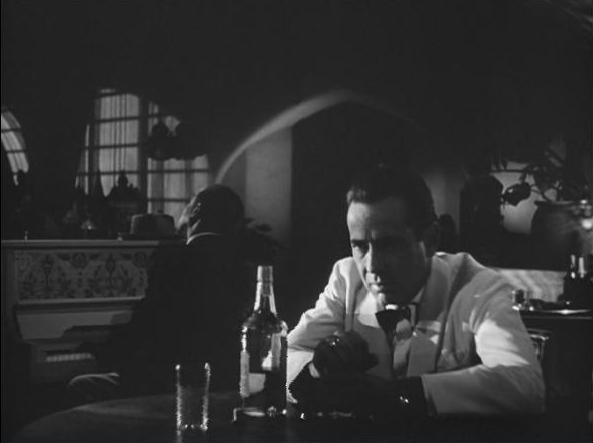
You must remember this. A film is just a film. Reviews are just reviews. No fundamental truths apply, but as time goes by, Casablanca is among the most consistent entries on everyone’s list. It’s the perfect movie to watch after you've been dumped, especially for guys. Anyone who’s had their heart broken badly can totally empathize with Rick, a cold, cynical nightclub owner who acquires the only plane tickets out of occupied Nazi-Morocco. In walks Ilsa -- the reason for his emoness -- with her new boytoy, desperate to flee the country. It's a great "love and war" drama that depicts those horrible feelings oh so wonderfully -- the way Rick can’t stand their old song yet still yearns to hear it, his disinterest in everything from other women to the War, and in his opening shot, what is he doing? Playing with himself. Granted, it’s a game of chess, but that’s about as suggestive as you could get in the forties. It was a very topical film (released less than a month after Allied Forces entered WWII) that had a huge impact on the nation, reflecting America’s shifting attitudes about the war and even inspired intervention. But personally, what I found to be the most influential thing in the film was the incredible amount of smoking and drinking. Sure, cigarettes were common in old movies because it looked so cool in B&W, but holy Marlborough! Try playing the drinking game during this movie. I dare anyone to take a shot every time a character takes a drink or a drag. You’ll pass out before Ingrid Bergman even enters the picture.


#42: The Terminator
1984

This was the iconic 80’s film. Robots, time-travel, car chases, gunfights, techno, miniatures, big hair… Terminator’s got it all! Two warriors from the future warp back to 1984: one is a cyborg assassin sent back to murder Sarah Connor, whose son will go on to lead a war against the machines in the post-apocalyptic future; the other is a soldier sent back to protect her. Terminator mixes action, sci-fi and horror into a gripping thriller that grabs you right from the start and only squeezes tighter and tighter. It was the breakthrough film for James Cameron, who would later make some of the most expensive films ever made. But I don’t give two shits about 3D movies if the characters in it are all one-dimensional. Terminator has a superb script that boasts strong characters, thought-provoking concepts and clever twists. Arnold Schwarzenegger is perfect in the title role, a single-minded, endlessly persistent, practically invincible hunter, one of the greatest screen villains of all time. Ahnold is so buff, it hurts just looking at him. The human soldier sent back to stop him doesn’t stand a chance, which is what makes the battle so exciting. The oldschool, low budget special effects are bound to elicit one of two reactions: "So fake!" or "So dank!" As a child, I thought that metal endoskeleton was the coolest monster ever. I would draw him all the time. Now that the effects have aged and I can tell it's all puppets and stop-motion, I think it's even cooler! Somehow, knowing how they did it engages me in the film even more. The only problem with the movie is it suffers from having the greatest sequel of all time. I’ll be back to review that one someday!


#41: Old Yeller
1957

I hate this movie, but it was an obligatory inclusion. In 1860’s Texas, young Travis becomes the man of the family farm after his father goes on a three-month cattle run. When a troublemaking stray dog appears, Travis wants nothing to do with it… but the mutt slowly grows on him. Yeller was the quintessential dog movie: a coming-of-age story filled with charming “boy and his dog” scenes, great animal stunts, and (SPOILER ALERT!) a heartbreaking, gut-wrenching, tear-jerking climax that caused many parents to shield the ending from their children. There was a Friends episode where a shocked Phoebe finally saw the real ending on TV, as her mother had always turned the movie off early, tricking her into thinking it had a happy ending. This was actually common practice in many households. Audiences in '57 didn’t even know what was coming. It was quite daring of the filmmakers to throw such a curveball ending on an otherwise lighthearted Disney western-family film. However, I think the film should be mandatory viewing for all dog owners. Strap the kids down and tape their eyes open. They gotta learn that Sparky ain't gonna live forever. At least the film has an uplifting resolution. This is more than just a movie; it’s a rite of passage.


And I'm just getting started. Click here for Part 2.